
Hearing happens in the brain. We help it practice.
Hearing aids and implants bring sound back in. Auditory training teaches the brain what to do with it, using the largest catalog of auditory training material.
How listening practice helps you hear
Hearing has two parts. Your ears, hearing aid, or implant turn sound into signals. Your brain works out what those signals mean. Auditory training works on the second part.
- Ear or devicecollects sound
- Hearing nervecarries the signal
- Brainstemsorts timing and pitch
- Auditory cortexturns sound into meaningTraining works here
- 01
When hearing changes, the signal changes
Hearing loss removes detail, often in high-pitched speech sounds like s, f, and th. Hearing aids and implants bring sound back, but it reaches the brain differently than before.
- 02
The brain has to relearn what it hears
Understanding happens in the brain: telling similar sounds apart, picking one voice out of many, and holding words in mind long enough to follow a sentence.
- 03
The brain changes with practice
The auditory system adapts to what it hears often. Studies have measured these changes in the brain after training and after regular hearing aid use.
- 04
Focused practice makes the changes count
Training gives the brain many clear examples with feedback, on the sounds and situations that are hardest. Studies report better speech in noise, faster neural timing, and less listening effort.
Read the research
Reversal of age-related neural timing delays with training
Proceedings of the National Academy of Sciences
Demonstrates that auditory training can speed up neural timing in the brainstem and cortex, directly improving speech-in-noise perception.
Read the paperAuditory training: Can we change the hearing brain?
Seminars in Hearing
A review of how auditory training changes the way the brain processes sound, and what that means for people with hearing loss.
Read the paperEfficacy of individual computer-based auditory training for people with hearing loss: A systematic review
Ear and Hearing
Henshaw and Ferguson conducted a systematic review of computer-based auditory training for individuals with hearing loss.
Read the paperAuditory training for adults with cochlear implants: A systematic review
International Journal of Audiology
A systematic review found consistent evidence that phoneme-level and nonword auditory training improves speech recognition outcomes in adult cochlear implant users, particularly in noisy conditions, with many studies showing lasting benefits.
Read the paperNeural Plasticity Induced by Hearing Aid Use
Frontiers in Neuroscience
Demonstrates neuroplastic changes associated with structured engagement with amplified speech in meaningful contexts.
Read the paperThe effect of auditory training on listening effort in hearing-aid users: insights from a pupillometry study
International Journal of Audiology
Demonstrates that structured auditory training reduces listening effort (pupillometry) even when accuracy remains stable, confirming that effort is a trainable metric in complex dialogue tasks.
Read the paperBenefits of phoneme discrimination training in a randomized controlled trial of 50- to 74-year-olds with mild hearing loss
Ear and Hearing
Ferguson et al. demonstrated that structured phoneme discrimination training improves perceptual performance and self-reported hearing ability in adults with hearing loss, with benefits persisting over time.
Read the paperComputer-based auditory phoneme discrimination training improves speech recognition in noise in experienced adult cochlear implant listeners
International Journal of Audiology
Schumann and colleagues conducted a randomized training study in experienced adult cochlear implant users showing that phoneme discrimination training can improve speech recognition in noise, with gains persisting over time.
Read the paperPerceptual learning and auditory training in cochlear implant recipients
Trends in Amplification
Fu and Galvin demonstrate that cochlear implant users benefit from structured training on basic auditory tasks, including detection, as a foundation for improving speech perception in noise.
Read the paperEfficacy of multiple-talker phonetic identification training in postlingually deafened cochlear implant listeners
Journal of Speech, Language, and Hearing Research Research
Miller and colleagues demonstrated that multiple-talker phonetic identification training with nonsense syllables improved difficult phoneme contrast perception and generalized to untrained voices.
Read the paperStimulus variability and the phonetic relevance hypothesis: Effects of variability in speaking style, fundamental frequency, and speaking rate on spoken word identification
Journal of the Acoustical Society of America America
Supports using multiple speakers. High variability in training stimuli (different talkers, rates) improves the robustness of lexical representations, preventing "over-learning" a single voice.
Read the paperEnvironmental sound training improves identification by cochlear implant users
Ear & Hearing
Shafiro, Rapson, and Gygi demonstrated that short-term computerized training significantly improved environmental sound identification accuracy in adult cochlear implant users, with gains of approximately 15%.
Read the paperAuditory training for central auditory processing disorder
Seminars in Hearing
Weihing, Chermak, and Musiek describe auditory training approaches for central auditory processing disorder that include environmental sound identification and discrimination tasks.
Read the paperAuditory learning and adaptation after cochlear implantation: A preliminary study of discrimination and labeling of vowel sounds by cochlear implant users
Acta Oto-Laryngologica
Adult CI users show auditory learning in vowel discrimination/labeling over time, with repeated listening experiences strengthening sound categories.
Read the paper
Results vary from person to person, and training works alongside your hearing care, not instead of it. See the full research library
Variety is what makes practice carry over
Practice with one voice in one room, and you get better at that voice in that room. Skills carry into daily life when practice varies what you hear, who says it, and where.
01What you practice: a catalog as wide as everyday listening
- listening activities
- 392
- speech, music, and everyday sound
- listening skills
- 33
- from noticing a sound to following a conversation
- real-world noise scenes
- 18
- for practice in noise
- soundscapes
- 43
- to relax, focus, or wind down
- Speech in noise and real-world scenes
- Word and sentence clarity, gist, and detail
- Working memory, sequencing, and following instructions
- Environmental sound awareness and figure–ground listening
- Conversation, social communication, and sustained attention
- Music, pitch, and fine speech-sound contrast where appropriate
02Who you hear: over 100 voices
Everyday conversation comes from many people. Practicing with many voices helps listening skills carry over to the people in your life, not only the voice you trained with.
Ages 18 to 86
Young adults through people in their eighties.
Men and women
Different pitches, timbres, and speaking styles.
Many accents
Southern, British, Australian, light Spanish, and light Indian English, among others.
03Where you hear it: real places and background voices
The hardest thing to hear through is other people talking, because it competes with the voice you are trying to follow. Activities can add background voices, from two people chatting to a crowd of eight, along with the places people actually spend time.
 Two people talking
 Four people talking
 Crowd of eight
 Cafe chatter
 Large crowd
Other places, for example
- Restaurant
- Busy street
- Supermarket
- Airport
- Living room television
A catalog that keeps growing
We add new activities, voices, and listening scenes all the time. In 2026 the catalog more than tripled, from 118 activities in January to 392 in October.
Next, activities can be generated in variations: new sentences, speakers, and backgrounds each time, so practice doesn’t run out. We expect a near-infinite number of variations by the end of 2027.
How training adjusts to you
No two people hear the same way. Our internal system, Pathfinder, learns from every session you finish and decides what to practice next, at what level, and how much background noise to use.
Chooses how loud the noise is
Pathfinder sets the signal-to-noise ratio for every activity: a little harder after 80% or better, easier below 60%, and never more than 3 dB in one session.
Fits your day
Each plan is sized to the time you set, 15 minutes by default.
Moves at your pace
Strong sessions move you up a level. Hard ones give an activity a few days’ rest instead of repeating it.
Brings skills back
Activities you are close to mastering return on a spaced schedule so they stick.
Listens to you
Marking an activity too hard or too easy shapes tomorrow’s plan.
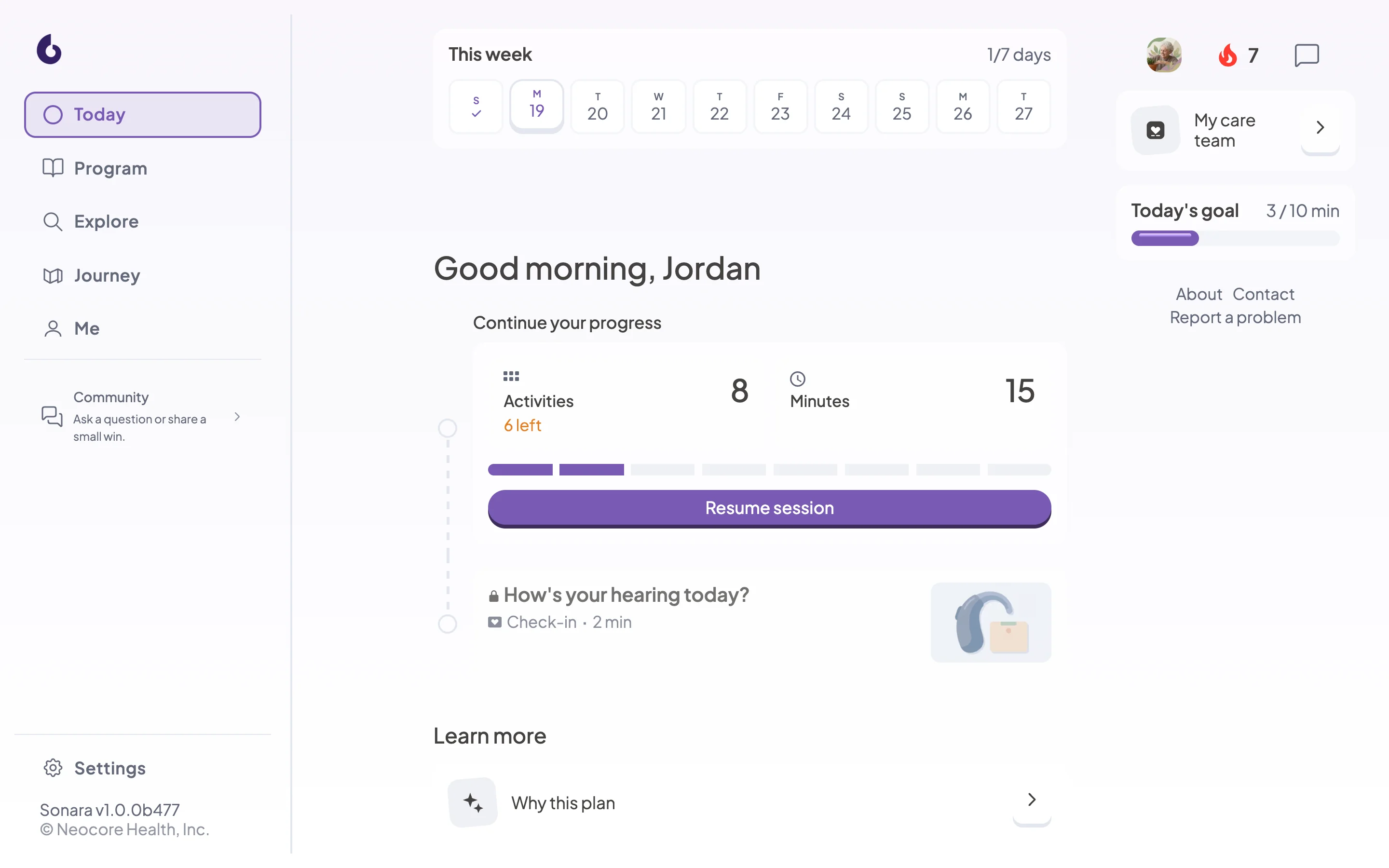
Why the order of practice matters
You start with easier listening tasks and build toward more complex practice. The program uses your progress across sessions to decide when you’re ready for the next challenge.
Listening for enjoyment counts too
Practice only helps if people come back to it, so Sonara also has listening you can do just for fun.


Interactive worlds
Two 3D worlds to explore, each with its own quests. Hundreds of sounds to find and follow, with listening challenges that get harder as you go.
Short stories
Hundreds of stories to listen to and follow.
Soundscapes
43 soundscapes to relax, focus, or wind down.
See auditory training in Sonara.
Sonara is where all of this comes together.