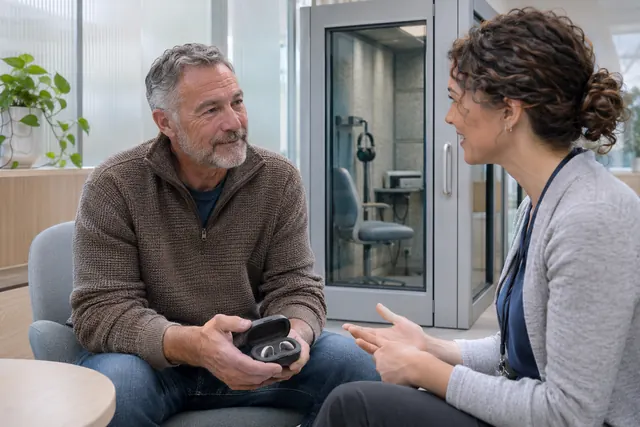

Supporting a veteran with hearing loss or tinnitus starts with understanding what they find difficult and what help they want. That might mean easier conversations, help organizing an appointment, or company while they work through a care plan. Their service history does not tell you how they feel, which symptoms they have or which treatment they need.
Hearing loss can make speech harder to follow. Tinnitus is the perception of sound without an external source, such as ringing, buzzing or hissing. They can occur together, but each may need its own assessment and management plan.1
Ask what matters before offering solutions
Try an open question: “What has been most difficult lately?” Follow the answer rather than assuming the main issue is the loudness of tinnitus or the volume of conversation.
Someone may be able to hear a speaker yet miss words in a busy room. Another person may be more concerned about sleep, concentration or feeling left out of family conversations. Those details help identify what support would be useful.
Do not press for a service story to explain the symptoms. The person can decide what to discuss and with whom. You can acknowledge a difficult experience without assuming a diagnosis such as post-traumatic stress disorder.
Ask before involving other relatives, contacting a care team or signing someone up for a program. Support is easier to accept when its boundaries are clear.
Make conversations easier to follow
Get the person's attention before speaking and keep your face visible. Move into the same room for important information. Reduce competing sound when possible, and take turns in groups. If something is missed, ask which part needs repeating and rephrase when that is more useful.2
An illustrative exchange might be: “Would you like me to repeat the whole plan, or just the time?” If a number or address matters, offer it in writing. These options let the person choose the format instead of guessing.
Hearing aids can help access sound, but they do not remove every difficulty with background noise.3 Continue using helpful communication habits when the person is wearing their devices.
A quiet setting is often useful for speech, while some people with tinnitus prefer gentle background sound in other situations. Ask about the purpose and the person's preference instead of applying one rule to every room or time of day.
Respond to tinnitus without arguing about it
You do not have to hear the sound yourself to take its effects seriously. “That sounds exhausting; what would help right now?” can be more useful than trying to persuade someone to ignore it.
Tinnitus care may include education, hearing care when appropriate, behavioral approaches and sound-based options. These approaches have different goals, and no single choice is suitable for everyone.1 A qualified clinician can help the person understand the options and the evidence.
Avoid promising that an app, supplement or sound will stop the tinnitus. Do not change medications or urge someone to stop a prescribed medicine because tinnitus is listed as a possible side effect. Bring the question to the prescribing clinician.
Offer ordinary company as well as symptom-related help. A conversation, walk or shared activity can remain about things the person enjoys. They should not have to report on tinnitus every time you meet.
Help navigate VA or community care
VA audiology describes services including hearing evaluation, hearing aid care, aural rehabilitation, tinnitus assessment and management, and virtual audiology. Availability and the appropriate access route depend on the individual's circumstances and local arrangements.4
If the veteran wants help, ask their VA facility or community clinician how to request hearing care. Confirm eligibility, referral requirements, costs and appointment options directly. Do not assume that every veteran qualifies for the same services or that a particular device or program is covered.
For someone already receiving care, the most useful assistance may be finding the correct contact for a hearing aid problem or the next follow-up. For someone new to care, it may be helping prepare a short description of the difficulty.
Neocore is a separate company. Information on this page does not establish VA affiliation, VA coverage or eligibility for any Neocore product.
Prepare without taking over the appointment
Ask whether the person wants you to attend and what role would help. Together, choose two or three priorities, such as following group conversation, managing tinnitus-related distress or understanding device options.
Useful notes include when symptoms began, whether one or both ears are affected, the settings that are difficult and any changes in sleep or daily functioning. Bring current devices and a list of questions. Let the clinician decide what additional medical history or testing is needed.
During the appointment, address the person directly and give them time to answer. Ask for important instructions in an accessible format. Before leaving, confirm what happens next, how to contact the team and which concerns should be raised earlier.
Keep home support practical and optional
If a care plan includes home activities, ask whether reminders are wanted. Agree on a manageable way to help: preparing a quiet space, joining a chosen conversation activity, or troubleshooting access with the clinic.
If the plan is not being used, ask why. Uncomfortable sound, fatigue, confusing instructions, cost or a difficult login may be the barrier. The care team can use that information to adjust the approach. A missed activity is not evidence that someone does not care about recovery.
With permission, bring one real-world example to follow-up: “The small meeting was easier, but the larger group is still difficult.” Useful progress can involve participation and effort as well as test results.
Recognize changes that need assessment
Sudden hearing loss is a medical emergency and needs urgent assessment, even if the person already has tinnitus or hearing aids.5 New or changing tinnitus, particularly a sound in time with the heartbeat, should also be discussed with a healthcare professional.1
For ongoing concerns, offer help making the next contact and ask what the person would like you to do. A dependable support role can be modest: listen carefully, improve communication and help carry out the decisions the veteran makes with their care team.