
Beyond the audiogram
An audiogram captures thresholds; it does not fully describe what it feels like to follow rapid speech in noise, decode a muffled consonant, or finish a workday with your brain fried from compensating. When auditory input is incomplete or noisy, the brain spends more resources inferring what was said, often trading away memory, speed, and emotional bandwidth.3
That gap between chart and experience is why many patients say they “hear but don’t understand.” The peripheral loss is real, but the bottleneck frequently shows up in central processing: prediction, phonology, selective attention, and semantic integration all have to work harder when the bottom-up signal is fragile.4
Work linking spectral and temporal resolution to speech-in-noise outcomes helps explain why two people with similar thresholds can diverge sharply in restaurants.1
Deprivation, reorganization, and use-dependent change
When auditory input is reduced for long stretches, the auditory system is not frozen; it adapts to what it receives. Animal and human neuroscience literature describes use-dependent plasticity along the auditory pathway: altered input can change tuning, timing precision, and the cortical resources allocated to speech.12
Hearing aid use itself has been associated with measurable neuroplastic changes when listeners engage consistently with amplified speech in meaningful contexts, not because the device is magic, but because it restores usable signal for the brain to learn from again.2
Training studies report that auditory training can speed neural timing in older adults, suggesting practice can influence biological encoding, not only motivation.5
This is not an argument for panic; it is an argument for timely, active management. The brain responds to statistics of experience. Rehabilitation tries to make those statistics look more like fluent conversation and less like avoidance.12
Listening effort and downstream consequences
FUEL-style models formalize what patients describe: effort is higher when the signal is degraded, so fewer cognitive resources remain for encoding, recall, and emotional regulation.3 Chronic effort can reshape social behavior, people skip restaurants, avoid phone calls, or nod along, which further reduces rich auditory practice.
That social spiral is one reason clinicians care about speech-in-noise outcomes and self-report, not only thresholds. If a person withdraws from complex listening environments, the auditory system gets fewer trials on the very statistics it needs to stay sharp.34
Semantic cognition research reminds us that word recognition is also meaning selection under competition. When the signal is fragile, those control processes overload faster.4
What structured training adds on top of devices
Reviews of auditory training emphasize that benefits are more likely when tasks resemble communication and include cognitive demand, not endless repetition of isolated cues.6 That is the scientific sense in which “brain training” and listening rehabilitation can overlap, when the protocol is serious.6
Pairing amplification with deliberate practice targets both sides of the bottleneck: restore audibility, then rehearse the skills real talk requires.26
What to do with this information
If you have hearing loss, the actionable lesson is simple: protect remaining structures (noise), treat early when appropriate, and rebuild skills with deliberate practice, not only louder sound. If you are a clinician, it is a reminder to measure function (SNR loss, effort, participation) and to prescribe training as part of a plan, not an afterthought.236
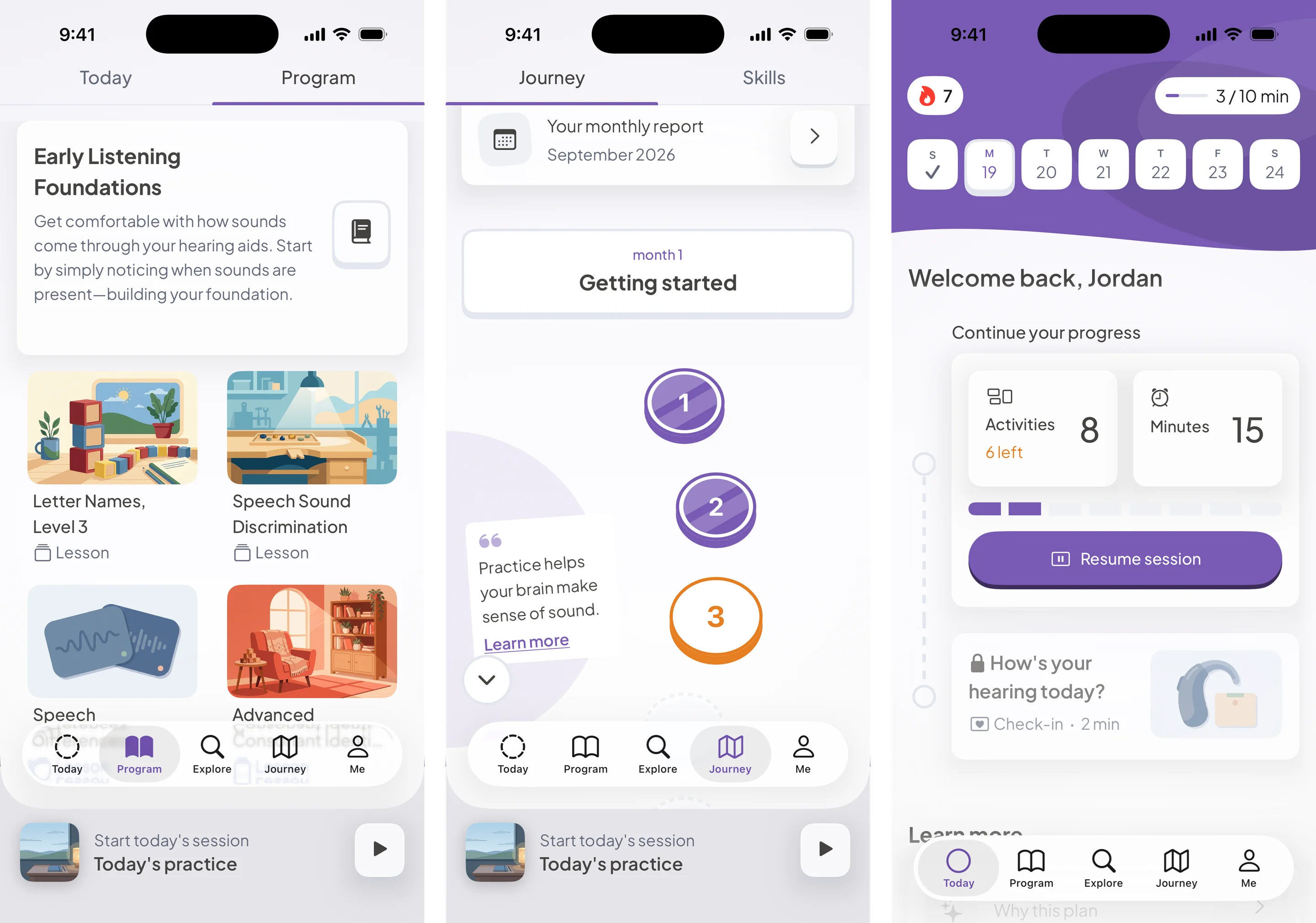
Sonara is designed around repeated, structured listening work that engages linguistic and cognitive demands, not isolated beeps, aligned with how the literature talks about generalization.6
None of this replaces individualized medical advice; it frames why rehabilitation is rational neurology, not a cosmetic add-on.125