
What auditory training means
Auditory training is not the same as wearing a hearing device louder or leaving the television on in the background. It means deliberately practicing specific listening tasks, often many short sessions over weeks, so that the brain gets repeated opportunities to refine how it parses speech, pitch, timing, or meaning in sound.1
Reviews in the hearing-science literature describe this family of interventions as a way to engage plasticity along the auditory pathway: when tasks resemble real communication demands (clear goals, graded difficulty, feedback), listeners may improve not only on the trained material but on related listening situations.1 That is why modern programs emphasize cognitive and “ecological” validity rather than endless repetition of a single isolated beep.
Clinicians sometimes frame auditory training as one pillar of rehabilitation alongside amplification, counseling, and communication tactics. The training itself can take many forms, discriminating consonants, following sentences in noise, or building up from simple detection tasks toward more complex speech tasks, depending on the person’s hearing status and goals.1
Evidence from controlled trials
Controlled studies in adults with mild to moderate hearing loss provide some of the clearest evidence that structured practice on speech-like materials can move outcomes that matter for everyday life. In particular, work using discrimination training on speech stimuli has reported benefits that can persist after the formal training period ends, which supports the idea that listeners are not merely memorizing items for a test. They are acquiring more stable perceptual skills.2
Research involving people who use cochlear implants reinforces a staged picture of learning: early training often targets foundational cues, what is audible, how contrasts differ, before layering on more linguistically rich tasks.3 That sequencing mirrors how rehabilitation teams think about building confidence and accuracy before pushing complexity.
Across these lines of evidence, a practical theme emerges: the strongest effects tend to appear when training is intense enough to matter but designed so that gains can transfer beyond the exact stimuli used in the lab or clinic.23 That balance is what separates “activity” from training in the scientific sense.
Neural timing and mechanisms
Why would repeated listening drills change anything durable? One bridge between behavior and biology is neural timing: the auditory system must represent fast fluctuations in sound with enough precision for speech features to remain intelligible, especially in noise or reverberant rooms.
Training studies using brainstem and cortical measures in older adults have reported that auditory training can speed aspects of neural timing, suggesting that at least part of the benefit from practice may come from sharper encoding of the acoustic signal rather than from listeners simply trying harder.4 That mechanism is especially relevant for rehabilitation narratives that emphasize “exercise for the listening brain,” not only for turning up volume.
Mechanistic work does not replace the need for well-designed behavioral trials, but it helps explain why benefits are often gradual and why consistency of practice matters: the nervous system is being asked to retune circuits that process sound in milliseconds.4
Who it is for, and how to evaluate a program
Auditory training shows up in clinical conversations for hearing-aid and cochlear-implant users, for adults rebuilding skills after neurological injury, and for people whose audiograms do not fully explain listening difficulty. The honest version is that not every listener needs the same task mix: the best programs match goals (speech in noise, music, localization) to the listener’s sensory limits and everyday demands.1
When you compare options, look for progression (tasks get harder in principled steps), feedback that teaches rather than punishes, and content that resembles real communication, not only tones in isolation. Reviews emphasize that training is more likely to generalize when it recruits cognitive control and linguistic processing, not only low-level detection.1
None of this replaces individualized care from an audiologist or physician, but it clarifies what “auditory training” is meant to name in the research: repeated, goal-directed listening work with the expectation that the auditory system can still learn.1
How this maps to everyday listening
Taken together, the literature supports a pragmatic view: auditory training is a structured form of practice aimed at perceptual learning, with the best evidence when tasks are tied to speech and real-world demands, and when outcomes are tracked beyond the final session of training.12
For readers evaluating apps, clinic programs, or home exercises, useful questions include whether the tasks escalate in difficulty, whether feedback is meaningful, and whether the program’s goals match your situation, for example, hearing aids versus cochlear implants, or speech in noise versus fine pitch discrimination.3
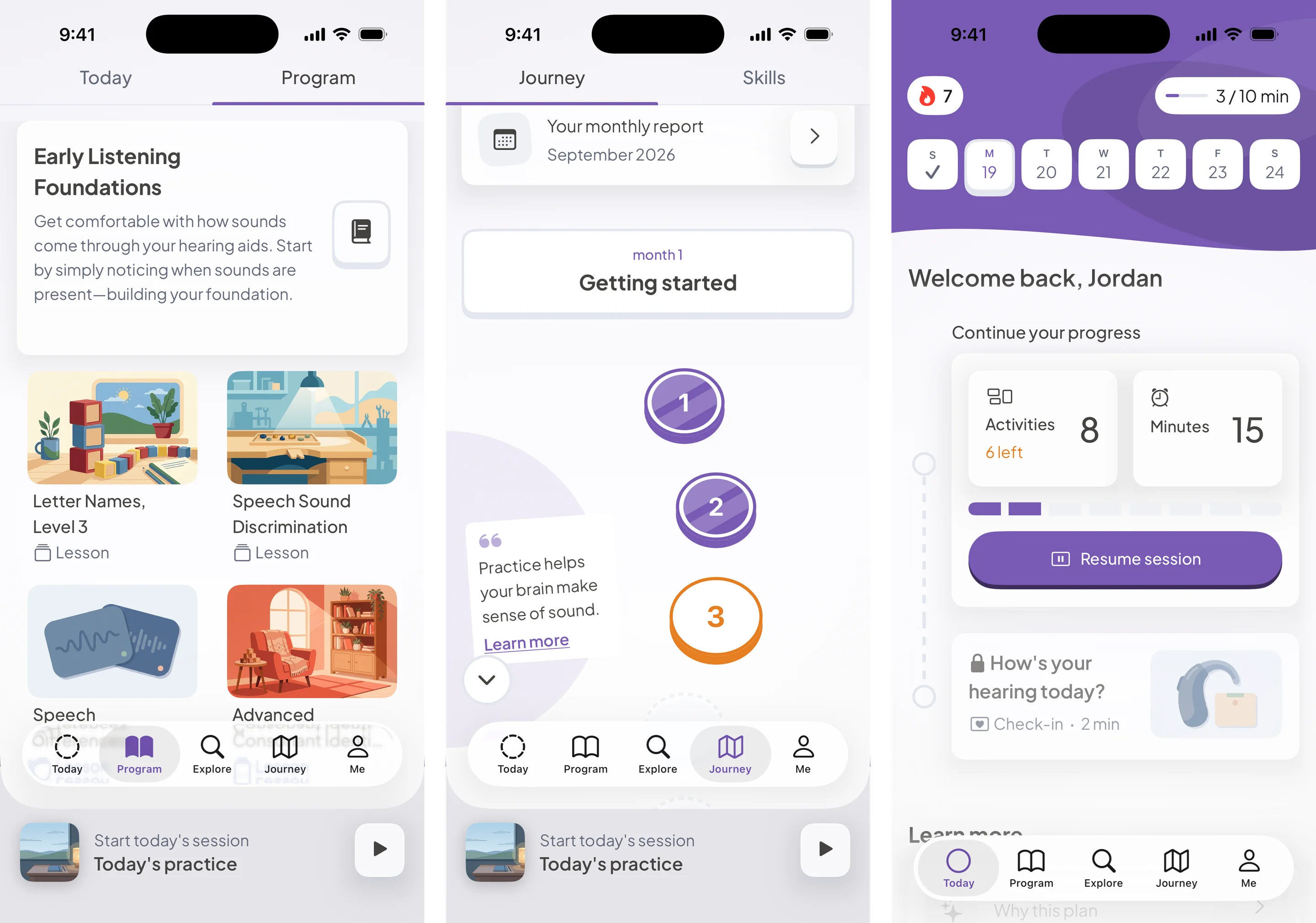
If you are exploring Sonara, think of it as a structured layer you can use between visits: short sessions, varied tasks, and a path that scales with you, not a single gimmick repeated forever. Bring questions to your clinician; they can help you set expectations and integrate training with amplification and communication strategies.1