Why this map exists
Patients hear “auditory training” and picture one thing; clinicians know it is a family of methods. The literature is clearer when you separate approaches by mechanism and failure mode, then sequence them like any other rehab plan.1
Bottom-up sensory training
Discrimination and identification tasks sharpen acoustic contrasts: phonemes, timbre, temporal gaps, and spectral detail. Strength: builds foundational resolution that downstream tasks assume. Weakness: if tasks stay artificial, listeners may excel in the lab yet stall in restaurants.1
Cochlear implant work shows early bottom-up foundations enable later linguistic gains. Skipping steps often costs time later.5
Top-down cognitive strategies
Prediction, context use, repair strategies (“can you repeat the last word?”), and gist-based listening help immediately in conversation. Strength: compensates for sensory limits in real time. Weakness: does not remove those limits, and can fatigue listeners if sensory support is inadequate.6
Speech-in-noise training
Targets the complaint patients actually register on intake forms. Strength: face-valid outcomes. Weakness: without careful SNR control and talker variability, you can either bore or overwhelm.14
Environmental and scenario-based training
Simulated cafés, spatial scenes, multitasking while listening. Strength: ecological validity and transfer to “real life.” Weakness: harder to standardize and validate than minimal pairs in a booth.1
Memory and sequencing
Working-memory loads force integration of speech fragments over time. Strength: links audition to cognition explicitly. Weakness: fatiguing if poorly graded; can frustrate patients if introduced too early.3
Music-based and rhythm training
Rhythm and pitch work can improve timing precision; musicianship literature links those skills to speech-in-noise performance, useful as a bridge when designed clinically, not as a miracle genre.2
Masking, similarity, and uncertainty
Classic cocktail-party work shows similarity between competing streams changes error rates. Training protocols that manipulate masker similarity train a different skill than pure SNR sweeps.4
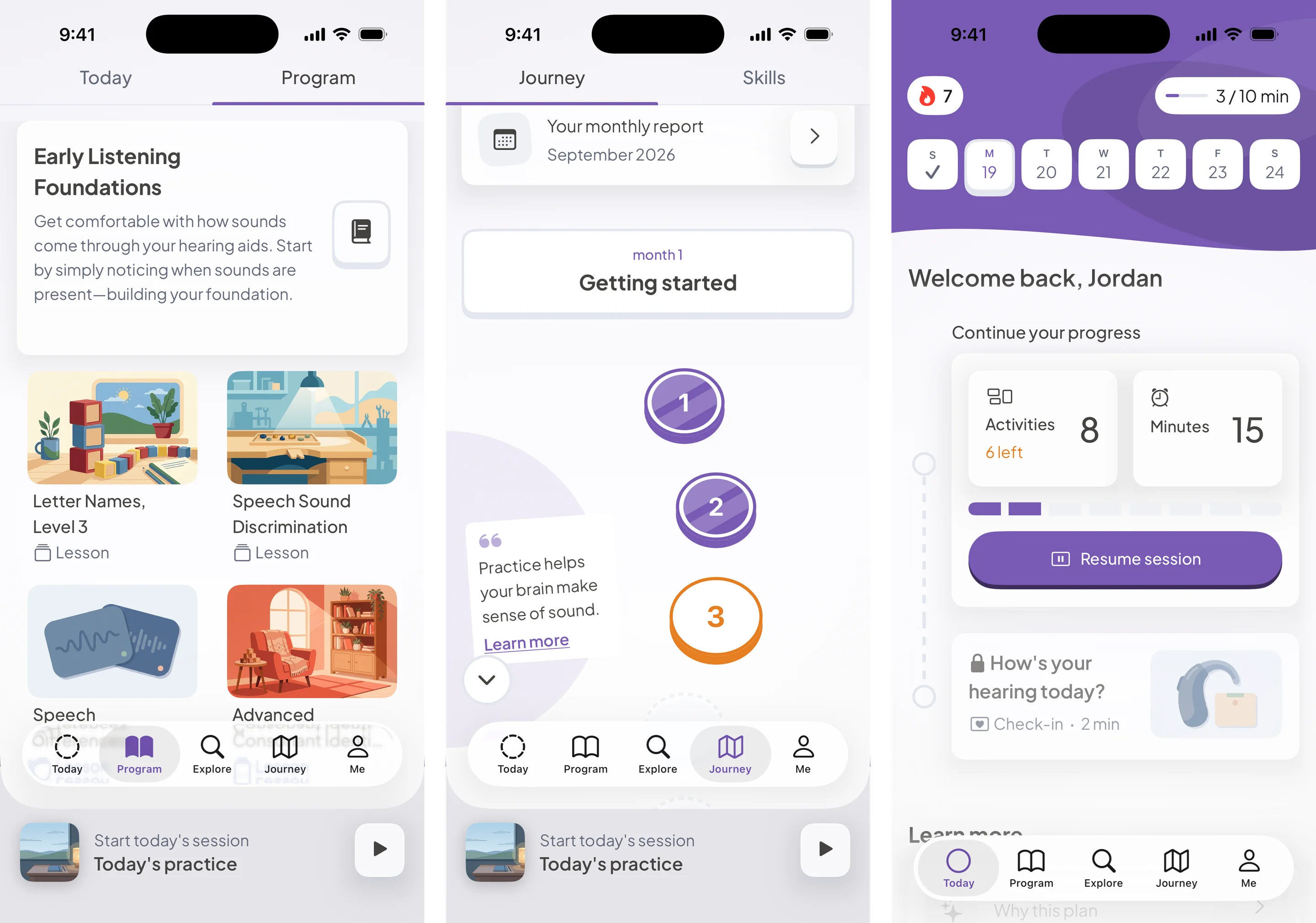
Why structure matters for Neocore
Fragmented apps pick one gimmick. Serious rehabilitation sequences skills, measures outcomes, and sustains adherence, what Sonara, Resona, and Link are built to operationalize together.1