

What “CBT for tinnitus” is actually trying to change
When people ask whether CBT “works,” they often mean: will my tinnitus volume drop to zero? Clinical CBT for tinnitus is usually more precise than that. The strongest evidence is for reducing the distress, fear, and functional interference that can spiral around the percept, changing how you respond to tinnitus, not magically erasing neural activity.
That matters because tinnitus commonly coexists with sleep disruption, anxiety, hypervigilance, and difficult listening situations. A therapy that targets catastrophic thoughts and avoidance can improve quality of life even on days when the sound is still noticeable. Meta-analyses and guideline reviews consistently place CBT among the better-supported behavioral interventions for tinnitus distress, especially when delivered by trained clinicians with disorder-specific protocols.
Neocore’s public reference export is weighted toward auditory neuroscience and training design rather than a dedicated CBT-for-tinnitus bibliography, so this article pairs a plain-language clinical summary with adjacent evidence on listening effort, training transfer, and sensory-cognitive interactions.1234
Listening effort and cognitive load
Many people with tinnitus also describe exhausting listening situations, crowded rooms, poor acoustics, rapid speech, even when their pure-tone thresholds look mild on a chart. The Framework for Understanding Effortful Listening (FUEL) gives researchers a shared vocabulary for that experience: when the auditory signal is degraded, understanding speech consumes more cognitive resources, leaving less capacity for memory, navigation of conversation, or emotional regulation.1
FUEL links sensory detail to measurable and self-reported effort, which helps explain why “hearing difficulty” and “cognitive fatigue” often travel together. For tinnitus specifically, intrusive sound can itself become another demand on attention, compounding the load described in FUEL.1
This page does not replace guidance from an audiologist or mental health professional, but it situates why evidence on listening effort is relevant when someone asks whether therapy “for the mind” could matter: if tinnitus increases the cost of everyday communication, interventions that reduce distress or improve coping may interact with that load, even when they are not identical to CBT.1
What large cognitive-training trials tell us about transfer
When patients ask whether “brain training” works, a fair answer starts with rigorous trials rather than app store slogans. The ACTIVE study and related work in older adults showed that specific kinds of structured cognitive training can produce durable improvements on at least some functional outcomes, demonstrating that training can be engineered to transfer beyond the exact game played on screen.2
That body of evidence is not the same as a catalog of CBT manuals for tinnitus, but it supports a general principle: mental skills can be trainable when protocols are sustained, supervised, and evaluated with credible endpoints.2
Readers comparing options should therefore distinguish three questions: (1) does a therapy have trial evidence for tinnitus distress specifically; (2) does it have evidence for related outcomes such as attention or executive function; and (3) does it fit the person’s clinical context, hearing loss, sound tolerance, sleep, mood.2
How auditory training is designed to generalize
Auditory training research asks a parallel question with sound at the center: can repeated listening tasks improve real communication when tasks are designed well? Reviews argue that benefits are more likely when training embeds cognitive-control demands, listeners might judge meaning versus sound identity, categorize words under time pressure, or inhibit prepotent responses, so that plasticity is not locked to a single laboratory stimulus.3
In other words, “more practice” is not automatically “better training.” The field emphasizes task architectures that resemble the complexity of speech understanding in the wild, including the need to integrate context and inhibit distraction.3
For someone with tinnitus, that design philosophy is indirectly relevant: if a program only measures detection of pure tones, it may say little about conversation; if it engages linguistic and attentional systems, it may overlap with concerns that also show up in psychological therapies, even though the mechanisms differ.3
Sensory limits versus cognitive test scores
A recurring tension in hearing healthcare is how to interpret cognitive testing when audiometric loss is present. Recent work cautions that poorer scores on memory or attention tasks may partly reflect inadequate audibility or degraded encoding of speech rather than a separate “pure” cognitive impairment.4
That caution matters for any discussion of CBT, mindfulness, or counseling for tinnitus: if listening is under-supported, psychotherapy may still help distress, but sensory factors can remain an unaddressed driver of fatigue and failure on challenging tests.4
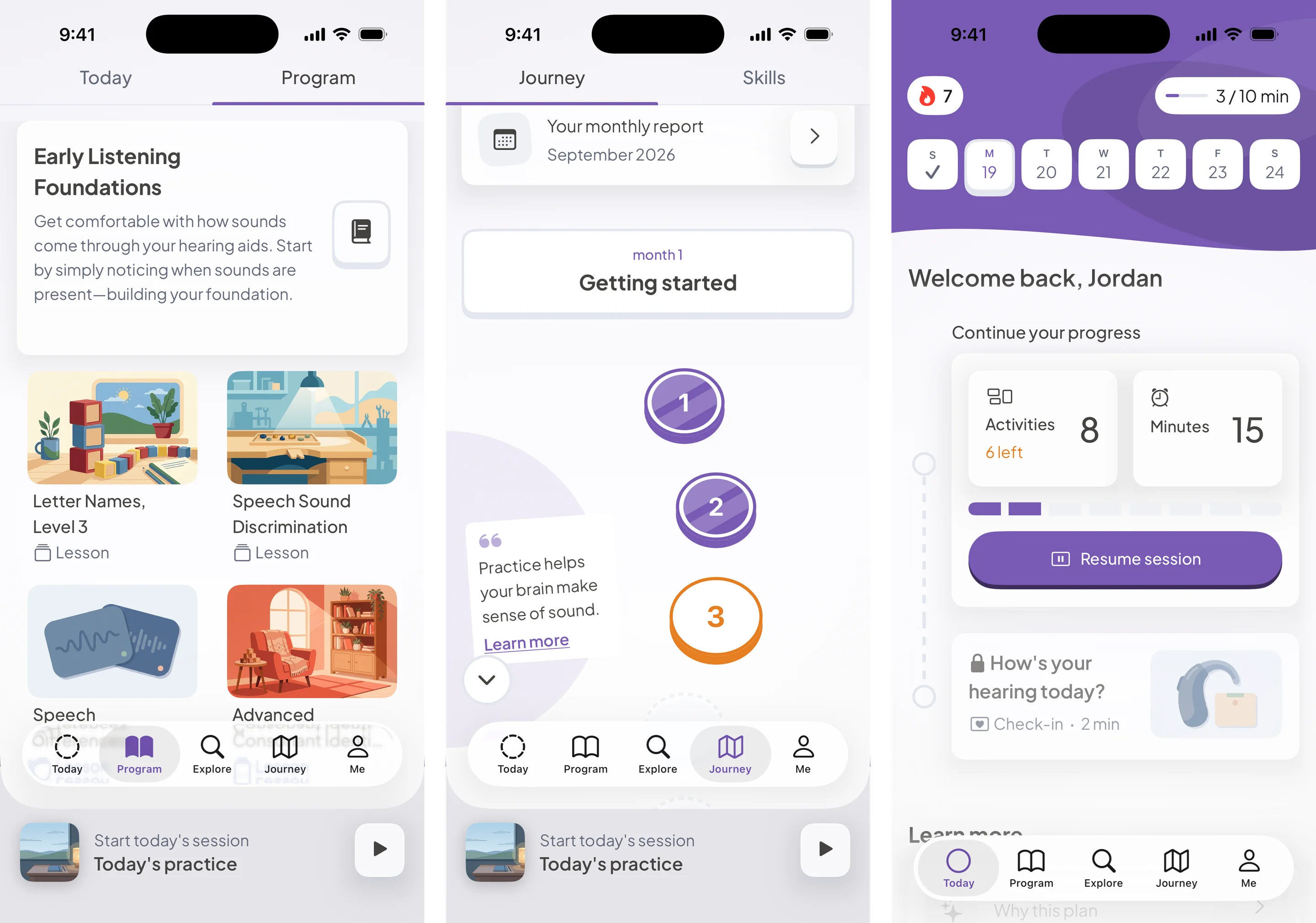
For individualized advice, including established tinnitus management approaches, readers should consult qualified clinicians familiar with both audiology and behavioral health. If you use Resona, think of it as structured education and skills practice that can sit alongside (not replace) clinician-delivered CBT when that is indicated.1234