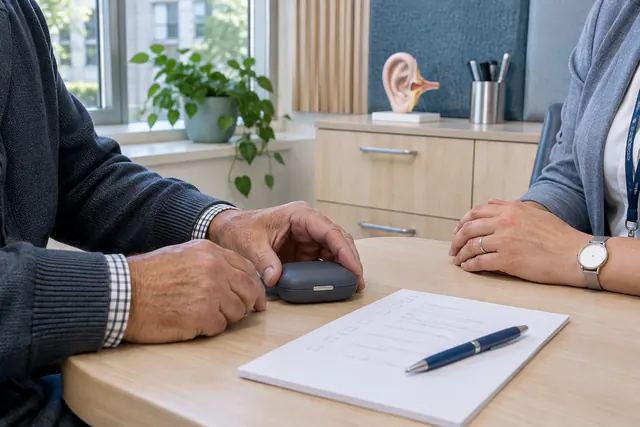
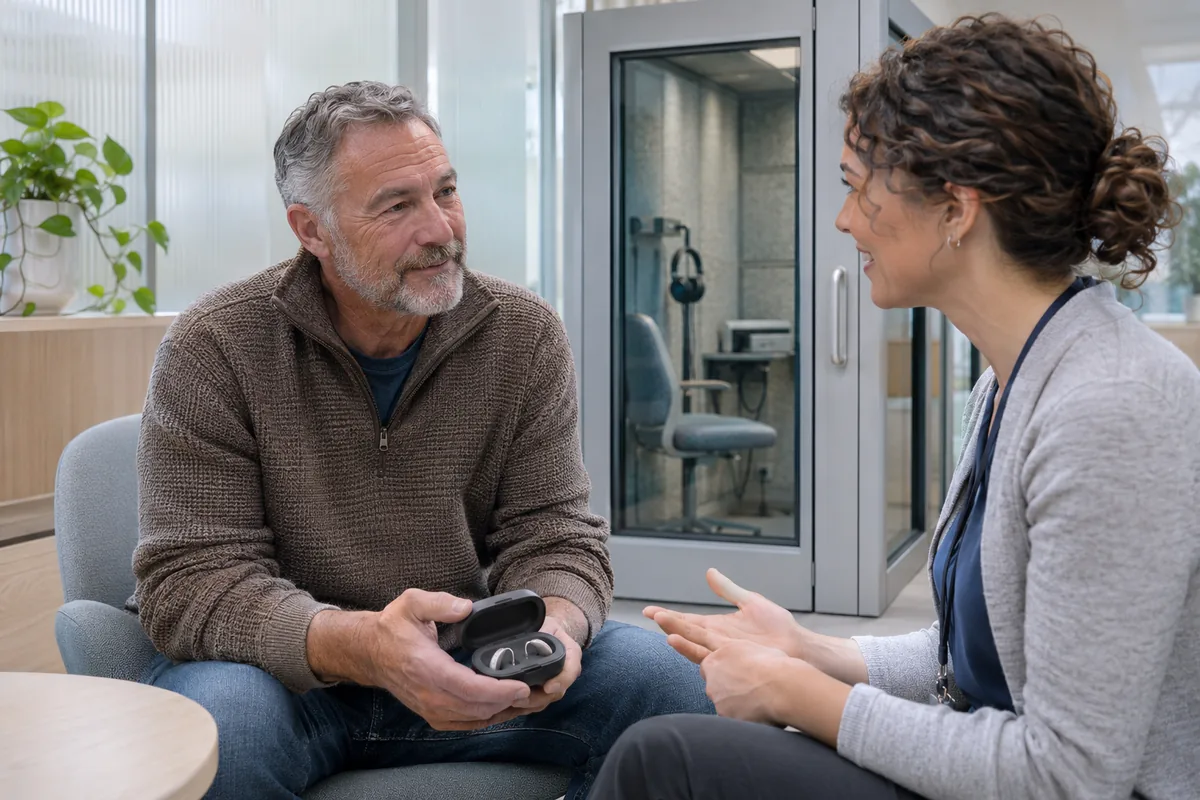
Veterans who notice hearing difficulty can start with a hearing evaluation and a discussion of the situations they want help with. Care may involve medical assessment, hearing devices, communication strategies, rehabilitation, or a combination. VA audiology provides services for hearing, tinnitus, and balance concerns; community audiology is another possible pathway.1
The right next step depends on your symptoms and circumstances. A routine hearing appointment is useful for ongoing difficulties, while a sudden drop in hearing needs immediate medical care.4
Describe what has changed
You do not need to know the type of hearing loss before seeking help. You might notice that speech is audible but unclear, that group conversations take more effort, or that one ear seems different from the other. Some people also have tinnitus or balance symptoms.
Tell the clinician when the difficulty began, whether it is changing, and whether it affects one or both ears. Mention relevant military and civilian noise exposure, hearing protection use, ear injuries, medical history, and medications. Provide the history without assuming that one exposure explains the whole problem.
A practical example is more useful than a broad complaint alone. “I can follow my partner in the living room, but miss staff instructions at the clinic reception desk” identifies both a successful setting and one that needs attention.
Work out the route into care
If you receive VA care, contact your local VA audiology service or healthcare team to ask how to arrange an evaluation. VA’s national audiology information describes its clinical services, but appointment arrangements and your personal circumstances should be checked directly.1
Ask whether you need a referral, which records to bring, and how hearing aid or rehabilitation follow-up is organized. If you are exploring VA healthcare for the first time, use VA’s official eligibility and enrollment channels. Do not assume that hearing difficulty alone settles coverage or benefit eligibility.
For community care, ask the clinic what services are included, how devices and follow-up are billed, and which costs your insurance or other program may cover. Get the details before making a purchase or committing to a course of care.
Neocore is a separate organization. This article does not establish a VA affiliation, endorsement, referral arrangement, or coverage for any Neocore service.
What a hearing appointment may include
The audiologist will take a history and select assessments appropriate to your needs. Ask what the results say about hearing sounds and understanding speech, and whether additional testing or medical evaluation is recommended.
If your main concern is a noisy environment, say so. An appointment should connect test findings with the situations you encounter, rather than stop at a description of hearing levels. You can ask whether testing or discussion can address speech in competing sound and whether tinnitus or balance concerns need their own pathway.
Bring existing hearing devices and any accessories the clinic requests. If someone accompanies you, decide beforehand what help you want from them. You remain the person whose goals and preferences guide the conversation.
Devices are one part of rehabilitation
Hearing aids can improve access to sound and speech, but do not remove all limitations caused by hearing loss.2 A fitting should be followed by a way to discuss comfort, everyday benefit, maintenance, and problems.
Depending on your assessment, the care team may discuss other technologies or a referral for additional evaluation. An article cannot determine which device is appropriate. Ask why an option is being recommended and what alternatives are available.
Rehabilitation can also focus on daily communication. You might learn to ask for the missing part of a message, plan seating in a group, or use written confirmation for important instructions. Some people discuss structured listening practice with a clinician. Its purpose and review point should be clear rather than assumed.
Choose a goal that fits your life
Consider an illustrative goal: “I want to understand the main discussion at my weekly veterans’ group and know who is speaking.” Possible changes include a different room arrangement, a one-speaker-at-a-time agreement, a compatible microphone system, and a conversation with the audiologist about the hearing-device setup.
Another person may prioritize a work call, time with grandchildren, or hearing an alert at home. These are different needs. A plan should reflect your own priorities rather than a standard list based on veteran status.
Assistive listening and alerting devices can support selected situations, with or without hearing aids, depending on the system.3 Ask for a demonstration and a compatibility check before buying accessories. Know how you will access important information when a device is charging or unavailable.
Make follow-up useful
Keep a few notes about situations that work and those that remain difficult. Include what you were using, what you missed, and what helped. “Quieter table and a clear view of the speaker helped” gives the clinician a practical comparison.
Ask when progress will be reviewed and whom to contact between visits. If a suggested activity or device is difficult to use, describe the obstacle: handling, cost, connectivity, travel, fatigue, or confusing instructions. Those are care-planning issues, not a reason to assume you failed.
If you are also seeking a service-connected disability determination or another benefit, ask the appropriate VA benefits office or accredited representative about that separate process. A clinical recommendation is not a guarantee about a claim or coverage.
Do not wait for a routine visit if hearing changes suddenly
A rapid hearing loss over hours or a few days can be a medical emergency, even if you suspect wax or a device problem. Seek immediate medical care.4 Tell the clinician about accompanying dizziness, tinnitus, pain, or other new symptoms.
For stable concerns, your next step can be simple: arrange an evaluation, identify one listening situation that matters to you, and ask how the results will lead to a practical follow-up plan. Good hearing care should help you participate in the life you choose.