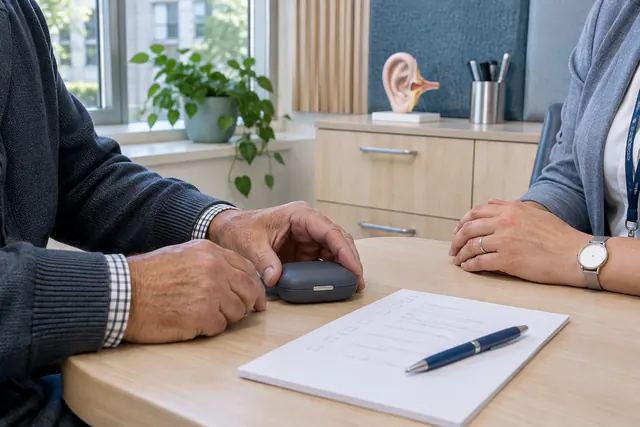

Hearing loss can make conversation harder without changing your interest in people or your ability to make decisions. If speech is becoming difficult to follow, a hearing evaluation and a practical communication plan can help you explore your options. Age-related hearing loss is common, but a change should still be assessed rather than dismissed as something you simply have to accept.1
The best starting point is what matters to you: talking with a partner, taking part in a group, handling appointments independently, or enjoying a familiar activity. Your preferences should guide the support you choose.
Notice the situations, not only the volume
You may hear a voice and still miss parts of the message. A quiet exchange might be comfortable while a restaurant, television, or conversation across a room is difficult. These details are useful to share at an appointment.1
Write down a few examples and when the problem began. Tell the clinician if one ear seems different, if hearing is changing quickly, or if you also have tinnitus, pain, or balance concerns. Avoid assuming that every difficulty has the same cause.
For an illustrative note, try: “I follow my friend when we sit together, but lose the conversation when someone speaks from the kitchen.” That gives the hearing professional a clearer situation to investigate than a volume preference alone.
Arrange an evaluation that connects to everyday life
Ask the clinician to explain the findings in plain language and discuss your priorities. If you are offered a device, ask what it is likely to help with, what limitations may remain, and how the fitting and follow-up work.
Bring a companion if you want one, and decide what role they should have. They might help remember questions or describe a shared situation. They should not replace your voice in the appointment.
If appointments themselves are difficult to hear, request an accessible arrangement in advance. You might need a quieter room, written information, an interpreter, captions, or another support. Ask for important instructions in a form you can review later.
Understand hearing-aid options without pressure
Hearing aids can improve access to sound and speech but do not restore typical hearing in every situation.2 Comfort, practical handling, follow-up, and usefulness in your own life all matter when choosing an option.
In the United States, over-the-counter hearing aids are intended for adults with perceived mild to moderate hearing loss. More significant or complicated hearing needs may call for prescription devices or another clinical pathway.2 If you are unsure which situation applies, seek professional advice before purchasing.
Ask about the full cost, any trial or return conditions, maintenance, repairs, and the support included. A device that is difficult to charge, clean, or adjust may need a different setup. Tell the provider about vision, dexterity, or connectivity needs when relevant; do not assume those practical issues have to be solved alone.
Make conversation a shared task
Tell people what helps you. A direct request can be brief: “Please face me and say my name before you start,” or “I heard the topic, but missed the person’s name.” Asking for the specific missing information can save both people from repeating everything.
For an important conversation, reduce competing audio and choose a place where you can see each other comfortably. If someone speaks from another room, ask them to wait until you are together. Clear natural speech is often more useful than shouting.
In a group, ask people to signal when the topic changes and avoid speaking over one another. If the group is making a plan, put the final details in writing so everyone has the same information. You should not have to guess and hope that you caught the right time or place.
Keep the activities you value accessible
Choose one activity you would like to continue or return to, then work through its communication demands. An illustrative example is a book group. You might sit where faces are visible, request one speaker at a time, and ask for the discussion questions beforehand. The aim is participation, not perfect hearing in every moment.
For a community venue, ask whether there is a hearing loop, captioning, or another assistive listening system. Confirm how to use it and whether it works with your equipment.3 If an option is unavailable, discuss a practical alternative before the event when possible.
You may prefer smaller gatherings, quieter times, or a different communication method for some activities. Those are choices to make for yourself, not evidence that you should withdraw from relationships.
Use technology for a particular purpose
Captions can help with video, calls, and meetings. Written chat can support names, dates, or unfamiliar words. Alerting devices may use visual or other signals to provide access to doorbells, telephones, and alarms.3
Choose tools by the problem they solve. If a smartphone setting is confusing, ask someone to demonstrate it and leave simple instructions. Avoid making several changes at once, which can leave you unsure how to get back to a familiar setup.
Check privacy before recording conversations or using services that store audio. For a medical appointment, ask the clinic about its accessible communication options rather than assuming that a personal transcription tool will provide an accurate record.
Review comfort, effort, and participation
After trying a change, ask yourself whether the situation became easier or more worthwhile. Did you join the conversation you wanted to join? Were you able to confirm the important information? Did the equipment feel comfortable?
Bring persistent difficulties to follow-up. Listening practice may be one topic to discuss, but it should not be used to avoid checking a device or changing an inaccessible environment. If a plan is too tiring, expensive, or complicated, say so. A useful plan must work in your actual day.
Hearing loss alone does not establish a problem with intelligence or decision-making. If you have separate concerns about memory or another health issue, discuss them with an appropriate clinician rather than allowing them to be inferred from a missed conversation.
Know when to seek prompt help
Sudden hearing loss needs immediate medical care, even if you think the cause may be wax or a hearing-aid fault.4 Ongoing one-sided or otherwise changing symptoms should also be discussed with a clinician rather than assumed to be ordinary aging.
For stable difficulties, start with one appointment and one communication goal. Ask for an explanation of the options, a practical next step, and a way to review whether it helps you stay connected on your own terms.