Helping an older loved one with hearing loss starts with asking what they want help with. Some people want a ride to an appointment. Others want their family to stop talking from another room. Useful support makes communication easier while leaving the person in charge of their choices.
Age-related hearing loss often develops gradually, and its effect depends on the situation. Someone may follow a quiet conversation but struggle at a family meal or during a medical visit. A hearing evaluation can clarify the difficulty and the available options.1
Begin with a specific, private conversation
Choose a calm moment. Describe something you have noticed without assigning blame: “The restaurant seemed difficult to follow. Would a quieter place work better next time?” This opens a conversation about an experience instead of asking the person to defend their hearing.
Listen to the answer. They may be concerned about cost, uncomfortable devices, an earlier disappointing appointment, or being treated differently. They may not want to discuss it today. Ask whether another time would be better.
Avoid arranging surprise hearing tests or using a family gathering to press the issue. You can offer information and help without turning acceptance of that help into a test of cooperation.
A useful question is: “What would you most like to make easier?” The answer might be talking with grandchildren, hearing a favorite program, or understanding a doctor. That priority can guide the next step.
Change your own communication first
The person should not have to carry every adjustment. Get their attention before speaking, keep your face visible and reduce competing noise where practical. Speak clearly at a natural pace. If something is missed, try a shorter rephrasing rather than repeating the same sentence increasingly loudly.1
At home, make important plans in the same room. At meals, move the conversation away from a loud television. When several people are talking, help return to one speaker at a time and mention when the topic changes.
Ask what works for this person. “Would you prefer that I repeat the last part, write it down, or say it another way?” gives them options. Do not assume that everyone can use lipreading, captions or written notes equally well.
For dates, medication instructions or travel arrangements, check the detail together. “Let’s confirm the address” is more respectful than asking someone to prove they heard correctly.
Offer help arranging an evaluation
Primary care clinicians, audiologists and ear, nose and throat specialists have different roles in hearing care. The appropriate starting point depends on symptoms and local services. An audiologist can assess hearing and discuss hearing devices and rehabilitation; a medical clinician can investigate conditions needing medical care.2
Offer concrete help: finding an accessible clinic, asking about fees, arranging transport or writing down questions. If telephone booking is difficult, ask whether the service offers another contact method.
A short appointment note might include:
- The conversations or settings that are most difficult.
- When the change was first noticed and whether it affects one or both ears.
- Any tinnitus, dizziness, ear discomfort or changes in hearing.
- Current devices and the problems the person wants to solve.
- One activity they would like to return to or enjoy more easily.
Let your loved one decide what to share. Family observations can be useful, but they should not replace the person's own account.
Agree on your role at the visit
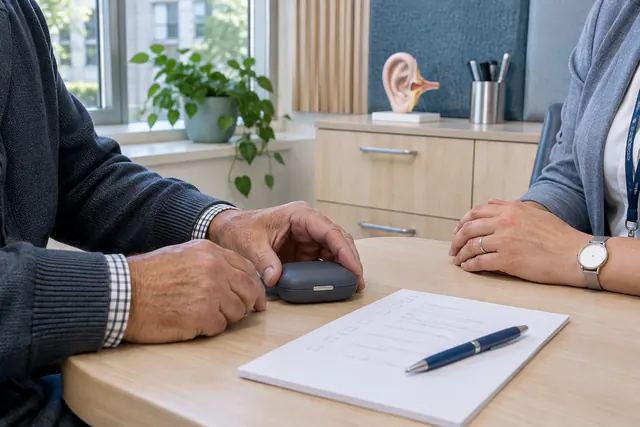
Ask whether they want you in the room and what role would help. You might take notes, remind them of one question, or join only for a discussion of communication at home.
Clinicians should address the person directly. If a question is difficult to hear, help improve access before answering on their behalf. A written summary or a quieter room may be more useful than another person speaking for them.
Before leaving, help confirm the next step: who to contact, what to try, what a follow-up will address and how to get an accessible copy of the plan. If information remains unclear, ask the clinician to explain it again.
Support device use without becoming the device police
Hearing aids can improve access to sound, but they do not restore normal hearing or remove all background noise. Adjustment, maintenance and follow-up are part of their use.3
If your loved one asks for help, learn the specific device instructions together. Practice charging or battery replacement, cleaning, insertion and storage with guidance from the hearing team. Keep small devices and batteries away from children and pets.3
When the device stays in a drawer, ask what is getting in the way. It may feel uncomfortable, sound wrong, be difficult to handle, or offer too little benefit in a particular setting. Those are useful reasons for follow-up. Repeated reminders to wear it may miss the actual problem.
Do not change clinical settings or arrange a replacement purchase without their involvement. Ask the audiologist about handling aids, compatible accessories or another support option if dexterity, vision or technology creates a barrier.
Keep enjoyable activities available
Plan for participation, not simply device wear. Ask whether a smaller gathering, quieter venue, captioned video call or different seat would make an activity more comfortable. Assistive listening and alerting devices can address needs that a hearing aid alone may not meet; suitability and compatibility should be checked.4
An illustrative family plan might be: choose a quieter table for Sunday lunch, ask everyone to face the group, and check afterward whether the arrangement helped. The person can decide whether to keep or change it. There is no need to turn the meal into a hearing exercise.
If fatigue makes a long gathering difficult, agree on breaks or a shorter visit. A successful outing can include using support and leaving at a comfortable time.
Know when routine support is not enough
A sudden loss or major drop in hearing needs urgent medical assessment. It should not be assumed to be aging, earwax or a device issue. NIDCD describes sudden sensorineural hearing loss as a medical emergency.5
For ongoing difficulties, return to the care team with a concrete example rather than concluding that nothing will help. “We can talk at home, but the weekly group is still hard” gives the clinician a more useful starting point than “the hearing aids don't work.”
Your most useful ongoing question may be simple: “Would you like help with this, or would you prefer to handle it yourself?” The answer can change as needs and preferences change.