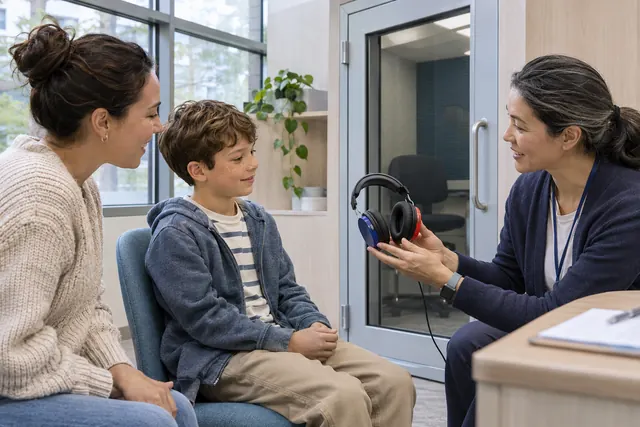
Children can experience tinnitus: a sound such as ringing, buzzing or humming that has no matching external source. A child may not use the word tinnitus or may assume everyone hears something similar.1,2 If your child describes an unexplained sound, listen calmly, ask what they experience and arrange an appropriate assessment when it persists, bothers them or comes with other symptoms.
The goal is to understand the child's hearing and well-being without creating unnecessary alarm. A report of tinnitus does not, by itself, identify its cause or tell you how much help the child needs.
Start with the child's own description
Invite the child to tell you about the sound in their words. You might ask, “What do you hear?” or “When do you notice it?” Give them time rather than immediately suggesting what it must sound like.
Younger children may prefer to draw, point to where they hear it or describe a familiar sound. Older children and teens may want to write down their experience. A 2024 pediatric tinnitus review emphasizes the importance of child-friendly assessment and the child's own account.2
Avoid asking the same question repeatedly throughout the day. If the child says it does not bother them, acknowledge that while still noting any other symptoms. If it does bother them, ask which part of the day is hardest. The loudness of a description is not the only measure of its impact.
Keep a few useful notes
Write down when the child first mentioned it, whether it appears to be in one ear or both, and whether it is constant or comes and goes. Note ear pain, hearing concerns, recent illness, injury or loud-noise exposure. Bring a medication list to the appointment rather than stopping prescribed treatment on your own.
Separate the child's report from what adults observe. “Says there is a tone at bedtime” differs from “seems tired in class.” Both may be useful, but one should not be treated as proof of the cause of the other.
A brief record is enough for an initial conversation. You do not need to ask the child to listen for tinnitus in a silent room or test whether they can still hear it every evening.
Arrange hearing and medical assessment
A pediatric healthcare professional or audiologist can help decide the next step. Hearing assessment is part of recommended tinnitus evaluation, and the approach should fit the child's age and abilities.3
Tell the clinic about any sound-related pain before testing. Ask how procedures will be explained, how the child can request a pause and whether a familiar adult can remain with them. Bring previous hearing results if available.
At the visit, let the child answer where possible, then add family observations. Ask what the assessment has shown, what remains uncertain and whether further medical or other evaluation is needed. Not every child needs every possible test; the clinical history and findings guide those decisions.
Recognize changes that need prompt attention
If hearing suddenly becomes reduced or muffled, seek urgent medical assessment rather than waiting for a routine tinnitus appointment.4 Acute severe symptoms, symptoms after a significant injury or a child who appears seriously unwell also need timely medical advice.
Tell the clinician if the child describes a heartbeat-like sound or persistent one-sided symptoms. Those details can affect the assessment.1 Do not rely on a sound recording or home hearing check to decide that evaluation is unnecessary.
For a child already receiving care, ask which changes should lead you to contact the team sooner. Written guidance can help caregivers respond consistently.
Ask about school and everyday life
Tinnitus support should consider the child's experience beyond the hearing test. NICE guidance specifically includes attention to children's emotional and behavioral well-being and age-appropriate ways of assessing impact.3
Ask whether the sound interferes with a lesson, reading, play, conversation or a quiet activity. A child may need help describing this without feeling that they are complaining. Avoid assuming that every distraction or school difficulty is caused by tinnitus.
With the child's involvement, decide what school staff need to know. A practical plan might identify a contact person, a way to ask for help or access to written instructions when needed. Keep the focus on participation and review whether any adjustment is actually useful.
Make bedtime support calm and practical
If tinnitus is noticed mainly at bedtime, ask what the child finds difficult. It may be the sound itself, uncertainty about what it means or another sleep concern. Share persistent sleep difficulties with the healthcare professional rather than assuming they will resolve when tinnitus changes.
A predictable bedtime routine and a reassuring explanation may be useful starting points. If a background sound is being considered, discuss suitability, comfort and safe use with the child's clinician. Do not turn it up to force tinnitus out of awareness or insist that the child listen when it causes discomfort.
For an original example, a family might agree that the child can mention the sound once, ask a question and then choose a familiar bedtime activity. The purpose is to provide support without making repeated tinnitus checks the center of the evening.
Be careful when interpreting treatment claims
The evidence for pediatric tinnitus interventions is less developed than the adult literature.2 A treatment that has been studied in adults is not automatically established for a child, and a digital product's availability does not establish pediatric suitability.
Ask the clinician what the proposed approach is intended to change. Is the goal better sleep, less worry, improved hearing access or another specific need? Ask what evidence applies to the child's age and what uncertainty remains.
A responsible plan should describe expected involvement, how the child can express discomfort, how benefit will be reviewed and when to stop or change course. It should not require a promise that tinnitus will disappear by a particular birthday or school term.
Keep the child involved in follow-up
At a review, ask the child what feels easier and what still needs help. Adults may notice a quieter reaction, but the child may still be struggling internally. Conversely, the child may be coping well even if they occasionally mention the sound.
Choose a practical goal together, such as enjoying reading or settling into the bedtime routine more comfortably. Agree on who to contact if symptoms change and when to review the plan. The most useful support combines appropriate assessment, a clear explanation and room for the child's own experience.