This activity gives you a structured way to notice differences between similar speech sounds. You listen to two short words and decide whether they are the same or different, then check the answer. It can be adapted with an audiologist to suit your hearing, language, and comfort.
Sonara's public product page includes a Speech Sound Discrimination activity. The example below is a separate home exercise illustrating the same general type of listening task; it is not a description of every step in the app.1
What you need
Use a quiet space, a willing partner, and a small set of familiar words. Your partner should speak naturally at a comfortable level. If you wear hearing aids or a cochlear implant, use the setup your care team recommends. You do not need to change programs, remove a device, or block one ear for this example.
Choose a way to answer that works for you: saying “same” or “different,” pointing to those words, or using two agreed gestures. If reading or speaking is difficult, arrange another response with your clinician. The activity should not become an accidental reading or speech test.
Choose a few clear examples
Begin with words you already know. A partner could use “tea” and “key,” or “coat” and “goat,” if those contrasts are clear in your shared language and accent. These are illustrative choices, not a prescribed training list.
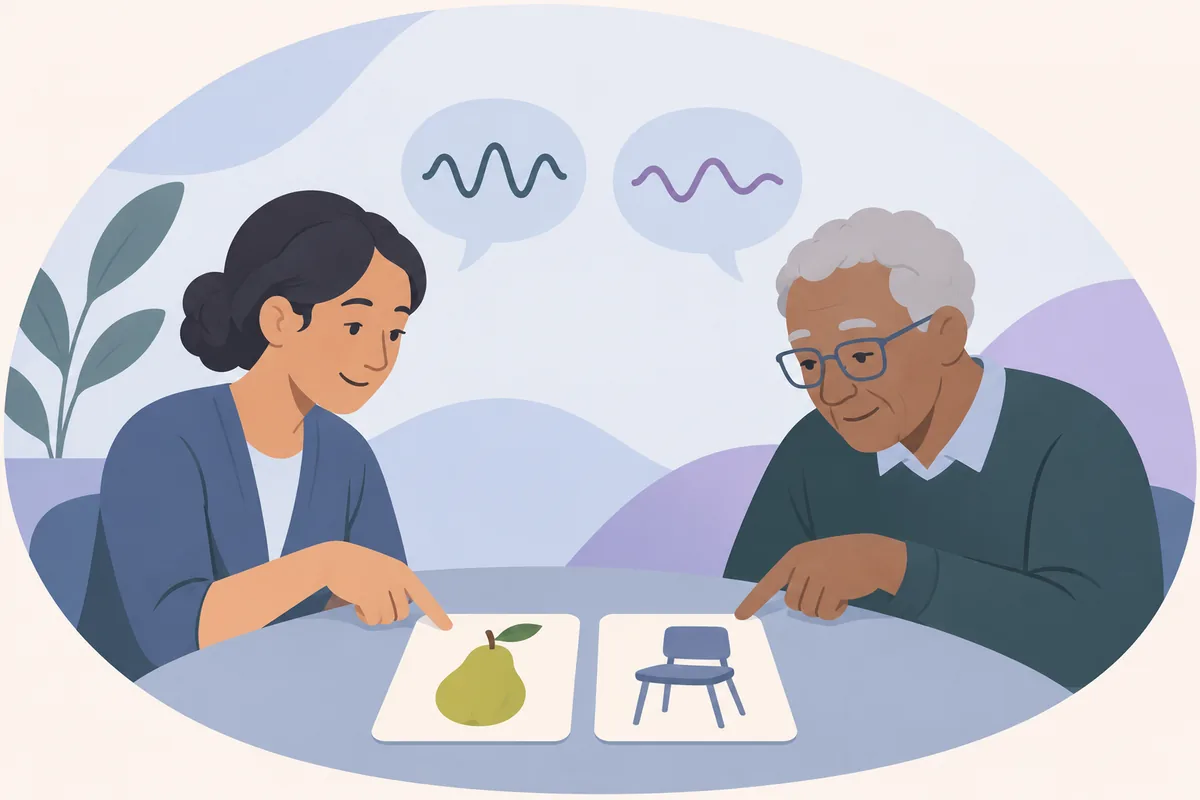
First say each word with its meaning available, perhaps by showing a picture or writing it down. Make sure both people agree on how it is pronounced. Do not interpret an unfamiliar word or an accent difference as a hearing error.
If a particular contrast is repeatedly confusing, choose an easier contrast or ask your audiologist which sounds are useful to practice. Repeating a mismatch many times without understanding it may simply be frustrating.
Try the activity
- Your partner says two words with a brief pause between them. They may say the same word twice or two different words.
- Decide whether the pair is the same or different. Ask for a repeat if that is part of the plan you agreed.
- Your partner tells you the answer without turning the exercise into a contest.
- If it was difficult, listen again while seeing the words or the speaker's face, whichever helps you understand the contrast.
- Try another pair when you are comfortable. Stop whenever you need a break.
For example, “tea—tea” is a same pair and “tea—key” is a different pair. Mix the order so that the answer is not predictable. If your partner always uses exaggerated speech, the exercise may differ considerably from ordinary conversation; keep the voice clear and natural.
Visual information is allowed. You can use it throughout or after an attempt, depending on the goal. Removing useful communication support is not a requirement for making practice worthwhile.
Make one adjustment at a time
To make the task easier, use more distinct words, show the choices, or repeat the pair. To explore a further challenge, your clinician may suggest a different speaker or another set of familiar words. Adding background noise is not a necessary next step.
Do not change the sound level, response method, speaker, and vocabulary all together. Keeping most conditions similar helps you work out what made the task easier or harder.
A few comfortable attempts may be enough for one session. The right frequency and duration depend on your needs. There is no required score to achieve before you are allowed to stop.
Notice the difference between practice and assessment
Research on phoneme discrimination shows that adults can improve on trained sound tasks, but improvements do not consistently carry over to speech in noise. Findings also depend on the participants and the training used.2 This home example has not been tested as a treatment and cannot diagnose a hearing or processing disorder.
If you record anything, note the words, listening setup, whether visual cues helped, and what you found confusing. A score is less useful if the task changed each time. Bring the pattern to your clinician, who can decide whether it suggests a useful training goal or a need to review another part of your care.
Know when to pause
Pause if the activity causes pain, marked distress, or an increase in sound sensitivity. Repeated confusion despite comfortable volume is a reason to simplify the task or ask for help, not to keep raising the volume. A sudden drop in hearing needs immediate medical assessment; other new hearing changes also deserve clinical review.3
Finish with an ordinary conversation or another activity you enjoy. You are practicing one listening distinction; communication also draws on context, visual information, questions, and the people talking with you.