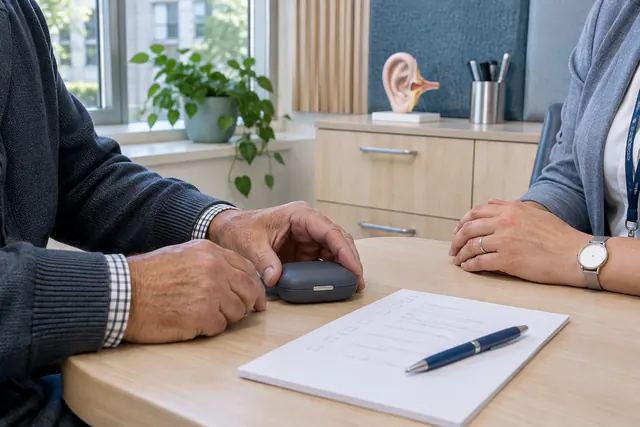

To practice listening at home, choose one meaningful task, make the listening conditions manageable, check what you understood, and adjust the activity based on the result. A useful routine does not need complicated equipment. It does need comfortable sound, clear feedback, and a reason for doing it.
If you use hearing aids or a cochlear implant, ask your hearing professional how practice should fit your care. Devices, hearing history, and communication goals differ, so an activity that suits one person may not suit another.1,2
Start with a situation, not a score
Think of something you would like to do more comfortably: follow a family voice message, understand a short announcement, or take part in a quiet conversation without losing the subject. Choose one situation for now.
Then identify the missing part. Are individual words unclear? Do you understand the first sentence but lose a longer message? Is the speaker easy to follow until another person starts talking? Write your observation in ordinary language. You do not need to diagnose the underlying cause.
For an illustrative goal, use: “I want to catch the main point of a short voice message and confirm the important detail.” This is specific enough to build an activity around and flexible enough to accommodate written support.
Prepare a comfortable setup
Choose a time when you have some attention and energy available. Reduce competing audio, sit where you can see a partner if one is involved, and use your usual recommended hearing setup. Check the device or connection according to instructions you have already received.
Keep sound comfortable. Increasing volume is not a reliable way to make unclear speech meaningful, and practice should not hurt. Avoid combining multiple speakers, unfamiliar material, and noise at the beginning; it becomes difficult to tell which part is causing trouble.
Have the answer available in a form you can use. That might be accurate captions, a written passage, a picture, or a partner who can confirm the message. If reading is difficult, choose another feedback method. Accessibility is part of the activity design.
Activity 1: listen, check, and revisit
Pick a brief recording with accurate matching text. An audiobook passage you can also read works well as an example; use material you have legitimate access to. Choose a familiar subject and only a few sentences.
Read the passage, listen at a comfortable level, and identify one detail. Check the text. Replay the sentence that contained the detail if you want to compare what you expected with what you heard.
Do not turn repeated listening into an endurance test. If the sentence remains unclear, move to shorter or easier material and note the difficulty. You can bring that example to your clinician, who may suggest a different setup or task.
Activity 2: practice a small choice
With a willing partner, choose a category and a short set of possible answers. For example, write “Monday” and “Friday” on a card. The partner says one day; you point or repeat, and they confirm the answer. You can keep their face visible.
Once the format is comfortable, change the choices or use a short sentence containing the day. Change only one element at a time. Adding more choices, length, distance, and noise simultaneously does not tell you which change affected performance.
These examples demonstrate how to create feedback. They have not been presented as a tested treatment program, and success with them does not diagnose or rule out a hearing condition.
Activity 3: rehearse a real conversation repair
Practice asking for the exact part you missed. A partner can give a fictional message such as, “We are meeting Sam at the library after lunch.” You might respond, “I caught the library, but who are we meeting?”
This activity focuses on keeping an exchange moving. It is useful even when the entire message remains difficult to hear. The partner’s role is to help repair the conversation, not award a mark or increase pressure.
Use invented information during practice. For real medical instructions, bookings, addresses, or financial details, obtain a reliable written confirmation rather than treating them as a listening challenge.
Choose a rhythm you can maintain
There is no single correct practice duration for everyone. If a clinician has prescribed a schedule, follow that plan and report any difficulties. Otherwise, begin with an amount of activity you can comfortably complete and discuss a suitable routine with them.
Tie the activity to an existing cue, such as sitting down after breakfast, if that makes it easier to remember. Keep the materials ready. A routine that requires five separate logins and a partner who is rarely available may need redesigning.
Missed sessions are information about the plan. Ask what got in the way: time, fatigue, confusing instructions, discomfort, boredom, or technology. Address the obstacle rather than trying to make up missed practice with a very long session.
Record one useful observation
A simple note can contain the date, activity, listening conditions, and what helped. For example: “Short audiobook passage, quiet room, hearing aids, written text. Understood the topic; names were harder. Replaying one sentence helped.”
You may also note how much effort the task took and whether you wanted to continue. Keep the wording consistent so you can compare your own experiences over time. This log is a discussion aid, not a validated clinical test.
Check an everyday goal separately. Did you participate in the family call you wanted to join? Did asking for a specific repeat make the exchange easier? A practice score and a meaningful change in daily communication are not interchangeable.
Keep useful supports in daily life
You do not need to remove captions, sign language, written notes, or other familiar supports to show that you are learning. Assistive devices can also make speech and alerts more accessible, depending on your needs.3 Ask which options might help with your particular situation.
For a partner, agree on when practice ends. Ordinary time together should not become a continuous test. Let the person practicing choose topics and tell you when they have had enough.
Know when practice should wait
Pause if sound is painful, equipment is uncomfortable, or the task causes persistent distress. Contact the appropriate hearing professional rather than repeatedly pushing through.
Seek medical care immediately for sudden hearing loss, including a rapid change in one ear. It should not be explained away as a practice problem or left until the next routine visit.4
For stable listening difficulties, take one goal and a few notes to your next appointment. Ask whether to continue the activity, simplify it, change the setup, or use another kind of support. A home routine should remain useful to your life, not become a separate obligation with no clear purpose.