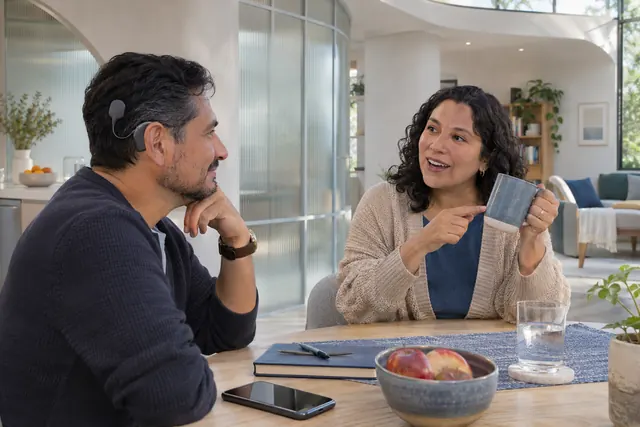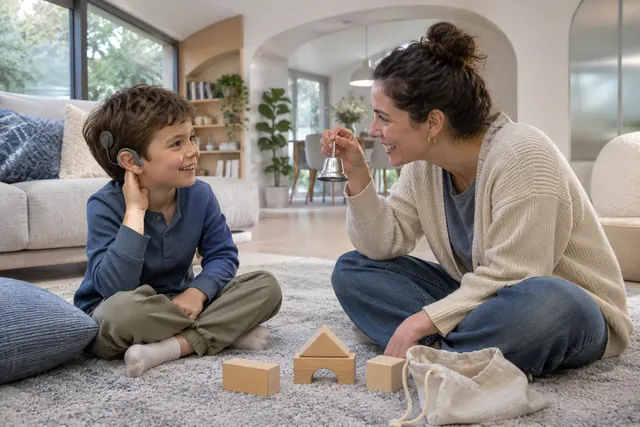

Useful cochlear implant listening exercises have a clear task, a comfortable level and a way to check what you heard. They can range from identifying a familiar sound to following the main point of a conversation. The best starting point depends on your hearing history, implant experience and personal goals.1,2
The activities below are illustrative options to discuss with your implant team. They are not a standardized treatment program, and there is no requirement to work through them in order.
Set up a session that gives you useful information
Choose a quiet place and confirm that your equipment is working using the checks your team has taught you. Use your prescribed programs and comfortable sound levels. If you use another implant or hearing aid, ask the team how to configure your devices for practice; do not independently change to listening with only one device.
Pick one task and decide what counts as the answer. “Name the sound from three choices” is clearer than “listen carefully.” Keep the materials short enough that you can review a misunderstanding without losing track of the entire activity.
Written choices, pictures, captions and a partner's face can all make practice more accessible. Whether to include or gradually reduce a cue depends on the purpose. They are not signs that the exercise has been spoiled.
Exercise 1: match a sound to a familiar source
Gather a small set of ordinary, comfortable sounds: a spoon moving in a cup, paper being folded or water running gently into a sink. Check that the sounds are safe and agreeable to you. Avoid sudden bangs, alarms or loud appliance sounds as practice material.
Ask a partner to make one sound while you choose from the visible objects or written options. Then confirm the source and listen again if you wish. Discuss what helped you recognize it: a rhythm, a repeated pattern or a change in duration.
To simplify, use two very different sounds and let yourself watch the source first. To vary the activity, introduce another familiar sound on a later occasion. The aim is to build a meaningful association, not to endure startling or unpleasant noise.
This activity is not a safety test. Recognizing a practice sound does not establish that you will reliably detect smoke alarms, traffic or other warnings in daily life.
Exercise 2: choose between words in a known category
Choose a topic that matters to you, such as ingredients, places you visit or family names. A partner says one item from a short visible list. You identify the item, then check the answer together.
Start with words that are easy to distinguish. If a pair is repeatedly confusing, make the choice smaller or return to a more distinct pair. Your clinician can help select speech contrasts when that is a specific rehabilitation goal.
To make the activity more relevant, place the word in a short sentence: “Please bring the tomatoes.” Keep the sentence format predictable initially. Later, vary the wording or speaker while keeping the vocabulary manageable.
Use errors as information. “I heard the beginning but missed the ending” gives you and your partner something to explore. It does not mean you should repeat the same frustrating item indefinitely.
Exercise 3: follow a short message and confirm the important detail
Have a partner read a short message, such as: “The library event is on Thursday afternoon.” State the main point and ask for any detail you missed. Check the written version together.
This activity practices both listening and clarification. You might say, “I heard the event is at the library. Which day?” That is often more efficient than asking for the whole message again.
For an easier version, preview the topic and keep the message to one piece of information. For a more demanding version, use a new voice or add one relevant detail. Avoid adding length, unfamiliar vocabulary and background noise at the same time.
Exercise 4: use a short recording with a transcript
Select a brief recording with an accurate transcript or captions, preferably on a familiar subject. Listen in the way that suits your current goal: with text from the start, or once before checking the text. Replay only a useful small section.
Compare what you understood with what was said. Did you lose a particular word, the speaker's main point or the transition between ideas? Use that observation to choose the next piece of material.
Captions do not always match speech exactly. If the text appears wrong, choose a more reliable recording rather than treating the mismatch as your error. Do not use confidential messages or recordings of other people without their permission.
Exercise 5: rehearse a conversation you want to have
Choose an ordinary situation, such as asking a neighbor about a delivery. Agree on a short exchange and practice a way to repair a misunderstanding: “Could you say the apartment number again?” or “Please show me the name in writing.”
Then change one part of the exchange so it is not purely memorized. Your partner might use a different greeting or provide a new detail. Keep the exercise collaborative, with the focus on getting the message across.
A useful endpoint is a strategy you can carry into daily life. Successful communication may include looking at the speaker, confirming information or using text. It does not require understanding every word without support.
How much should you do, and how do you progress?
Agree on duration and frequency with your team. A tolerable routine you can sustain is more useful than an ambitious schedule that leaves you depleted. Pause if sound becomes uncomfortable or the task stops providing useful feedback.
Adult cochlear implant training research suggests possible benefits, but the studies are varied and often small. No single set of home exercises is established as the best approach for every recipient.3 These examples should therefore be adapted, not treated as a prescription.
Record one short observation after a session. For example: “The written choices helped; a new speaker was harder.” At follow-up, pair that note with something from daily life. Better performance on practiced material is encouraging, but broader communication needs a separate check.
When practice should give way to clinical advice
Contact the implant team for pain, skin irritation, unexpected device behavior or a marked change in the sound you receive.2 Do not respond by increasing volume or repeatedly changing programs on your own. Sudden loss of natural hearing needs immediate medical assessment.4
Choose one activity tied to something you want to do, and ask your team how to make it appropriate for you. The purpose of home practice is to support participation between visits while keeping your goals, comfort and access needs in view.