Cochlear implant listening practice for a child works best when it fits the child’s communication goals and the plan developed with their implant team. Home activities can give the child opportunities to connect sound with meaning, but they should remain part of an accessible, supportive language environment. An implant does not produce the same experience or outcome for every child.1
Parents do not need to turn the whole day into therapy. A shared book, a familiar game, or an ordinary routine can provide a useful starting point when the activity is chosen for the child’s needs.
Ask what your child is working on now
The implant team may include an audiologist, speech-language pathologist, teacher, and other professionals according to the child’s needs. Ask them to explain the current goal in ordinary language and demonstrate a home activity.2
Your child may be working on noticing sounds, recognizing familiar words, understanding messages, or managing a more complex communication situation. The activity should match that goal rather than the child’s age alone.
Clarify the equipment setup, including use of a hearing aid or implant on the other side. Follow the individualized wearing and programming guidance. Do not change clinical settings or remove useful hearing support to make an exercise more challenging.
Ask how you should respond if the child finds the task confusing or refuses it. A plan should include ways to simplify or stop, not only instructions for increasing difficulty.
Keep language accessible
Listening practice should not take away reliable communication. Use the spoken, signed, visual, or combined communication approaches that meet your child’s needs and the family’s goals.3 The child should be able to understand important information whether or not a listening activity succeeds.
Some clinician-directed tasks may temporarily focus on listening without a particular cue. Ask why, for how long, and how that fits the child’s wider communication. A brief exercise is different from limiting access to language throughout the day.
Follow the child’s interest. If they are fascinated by a picture, a toy, or a daily task, use that shared attention as a place to communicate. They do not have to earn the answer by guessing repeatedly.
Example: a familiar play routine
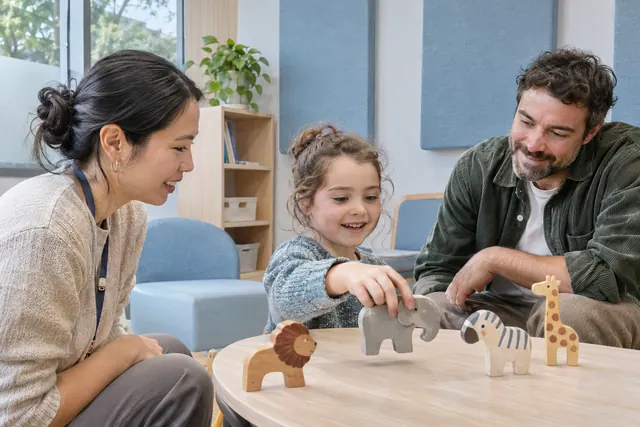
Here is an original illustration to discuss with your child’s clinician. Put two familiar toy animals where the child can see them. Name one during play and help the child connect the word with the animal. If selecting between them is part of an agreed goal, invite the child to choose and confirm the answer.
Make the game enjoyable in its own right. Let the animal jump, hide, or join another toy. If the child is no longer engaged, continue ordinary play or choose a different activity. Repeating the same question until the child guesses correctly may tell you more about frustration than listening.
The clinician may suggest changing the vocabulary, number of choices, or level of support. Do not assume that more choices or less visual information is always the appropriate next step.
Example: shared reading
Choose a short, familiar book. Look at a picture together and communicate about what the child notices. You might repeat a recurring phrase, name a character, or pause for the child to contribute in any accessible way.
If the team has selected a listening target, incorporate it briefly and naturally. For instance, the target might involve recognizing a familiar character’s name in a short sentence. The rest of the reading time can remain a shared story rather than a series of test questions.
For an older child, choose material that respects their interests and maturity even when the listening task is simple. A short discussion about a favorite game can be more appropriate than preschool materials chosen solely because they contain easy words.
Example: an everyday routine
Use a routine with a clear beginning and end, such as preparing a snack. Tell the child what is happening, show the objects, and confirm any choice. A clinician might help you select one small listening opportunity within that routine.
Use fictional or low-stakes details when practicing difficult comprehension. Real allergy information, medication instructions, or safety rules must be communicated reliably; they should not become tests of what the child can hear.
Choose a time when both you and the child have some energy. If the routine is already rushed or stressful, it may be a poor place to add practice. The care team can help find a more workable opportunity.
Notice what helps and share it
A useful note contains the activity, the support, and the child’s response. For example: “During the animal game, two choices were manageable; more choices led to guessing.” Another might be: “My child enjoyed the story but did not want repeated questions.” These are illustrative observations, not developmental benchmarks.
Include the child’s own description whenever possible. Ask whether something sounded strange, was hard to understand, or simply was not interesting. Older children may want to keep their own notes or choose what the parent shares.
Bring these examples to follow-up. The team can compare them with clinical assessment and decide whether to change the activity, equipment setup, or goal. Do not equate an app score with the child’s overall language development or school participation.
Coordinate the plan across adults
Agree on the essentials with caregivers and school staff: the child’s communication approach, the current goal if relevant, basic device responsibilities, and the contact route for problems. Share only the information each person needs.
Avoid creating separate demanding routines in every setting. A child may already spend substantial energy listening and learning at school. Ask the team to consider the total day when recommending home activities.
Check access to classroom speech and alerts as well as practice. Compatible assistive listening and alerting technologies may be useful, with appropriate assessment and setup.4 The child should have an accessible plan when equipment is unavailable, too.
Respond to discomfort and protect ordinary family time
Contact the implant team for pain, skin redness or irritation.5 Report device problems or an unexpected change in the child’s hearing experience, too. Do not encourage the child to push through pain to complete an activity.
Keep time for play and conversation without a rehabilitation goal. A child’s willingness to participate is not a measure of their worth or your effort as a parent.
At the next visit, ask for one demonstrated home activity, one way to adapt it, and one observation to bring back. That gives practice a clear role while keeping your child’s communication, comfort, and interests at the center.