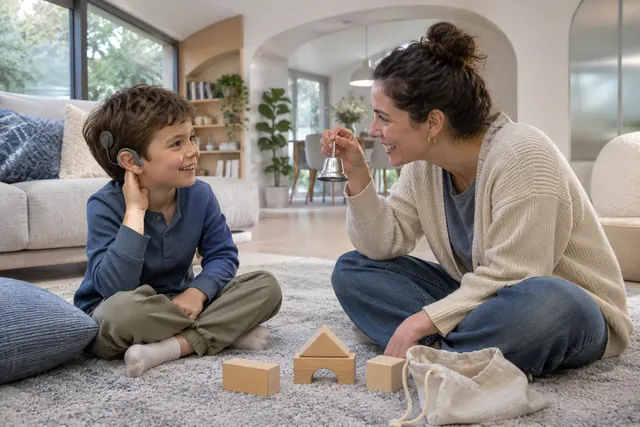

Supporting a child with hearing loss at school means making spoken and other classroom information accessible throughout the day. Hearing devices may be part of the plan, but teachers, room conditions, visual information, language access, and the child’s preferences also matter.1
A useful plan is specific enough that a teacher knows what to do on a normal day and when something goes wrong. It should be developed with the child, family, school, and relevant hearing or communication professionals.
Begin with the child’s school day
Walk through the day from arrival to leaving. Whole-class teaching is only one setting. Consider small-group work, assemblies, lunch, sport, videos, transitions between rooms, and conversations with friends.
Ask the child where they can follow comfortably and where they miss information. A child might hear the teacher well at the front of the room but struggle when classmates answer from behind. Another might manage lessons but miss last-minute changes during noisy packing-up time.
An illustrative starting question is: “When do you know what to do next, and when do you have to look at what everyone else is doing?” This invites useful detail without blaming the child for missing an instruction.
Bring the right people into the plan
Depending on the child and school, the team may include a classroom teacher, educational audiologist, teacher of deaf and hard of hearing students, speech-language pathologist, interpreter, special education professional, and healthcare audiologist.1
Ask who coordinates communication and who is responsible for each action. “Use the microphone” is incomplete if no one knows where it is charged, who checks it, or what to do when a substitute teacher arrives.
Share clinical information with appropriate consent and a clear purpose. A teacher may need to know the child’s preferred communication setup without needing a complete medical history. The child should have an age-appropriate voice in what is shared and how.
Design instruction so important details are available
Discuss ways to present key instructions, new vocabulary, and deadlines in a visible format. Written steps, pictures, demonstration, captions, or an interpreter may be appropriate depending on the child’s language and communication needs.
Get attention before giving a message. Keep the relevant speaker visible when that supports access, and avoid giving critical instructions while facing the board or moving away. After a complicated direction, check what the child understands in a respectful way.
For an illustrative science lesson, the teacher might show a short sequence before students begin moving materials. The child can refer back to it without having to interrupt repeatedly. This also makes it easier to identify whether a difficulty concerns hearing the direction, understanding its language, or carrying out the task.
Avoid relying only on “Any questions?” A child may not know that they missed something. A private check of the next step can reveal more than a general invitation in front of the class.
Match seating to the activity
There is no universal best seat. Access depends on where speakers are, the child’s hearing and visual needs, room acoustics, lighting, and the activity.
A position near the teacher may be useful for a presentation. A circle or another arrangement may be more accessible for discussion. Ask the child and educational audiologist to consider the actual classroom rather than treating “front row” as a complete plan.
Reduce avoidable competing noise when practical. Close a noisy door if appropriate, pause background music during instructions, and establish a turn-taking routine. These changes do not eliminate every challenge, but they give the child a better chance to access the information being taught.
Use hearing technology with a clear support routine
Remote microphone and other assistive listening systems can help deliver a speaker’s voice more directly to compatible equipment.2 Selection, fitting, verification, and classroom use should involve appropriate professionals. A device should be tested in the setting where it will be used.
Ask practical questions. Who checks it each morning? How does it work during group discussion? Can the child signal a problem without interrupting the entire lesson? What happens if the microphone is muted, uncharged, or taken to another room?
For hearing aids, clarify which routine checks staff are trained to perform and when the family or clinician should be contacted.3 Staff should not improvise clinical programming or repairs. Have an accessible backup lesson and communication plan so a device problem does not remove the child from learning.
Make videos, discussion, and assessments accessible
Check videos before the lesson for accurate captions and any additional communication support the child needs. Captions should be readable, synchronized, and visible from the child’s position. Automatic captions may require checking, especially for names and specialized vocabulary.
During discussion, identify the speaker and allow one person to finish before another begins. If a peer’s comment is not accessible, repeat or summarize it through the agreed communication method before building on it.
Ask whether an assessment is measuring the intended academic skill or unintentionally measuring how well the child hears the instructions. The appropriate adjustments depend on the task and formal school arrangements. Clinical and educational staff should help decide how to preserve the purpose of the assessment while ensuring access.
Include social life and self-advocacy
Support should extend to clubs, lunch, outings, and friendships. Ask the child which situations they want help with and which they prefer to handle independently.
Practice a short request if the child wants to: “Please face me,” “Can you repeat the last part?” or “I need the instructions written down.” Adults should respond consistently so asking for access is useful rather than embarrassing.
Do not make the child responsible for every environmental problem. Self-advocacy grows alongside reliable adult support. A child should not need to repeatedly prove that a documented need still exists.
Review what changes in practice
Choose a few observable outcomes. Can the child start the task after instructions? Are they joining discussions they want to join? Can they report a device problem and receive help? Include their experience of effort and comfort, not only marks or wearing time.
Agree on a review date and a contact route for difficulties. Revisit the plan after changes in teacher, classroom, timetable, hearing, or equipment. Formal educational support processes and eligibility vary by location; ask the school which arrangements apply to your child.
A useful next meeting can focus on one difficult part of the day, one change to try, and who will check whether it helps. That turns a broad request for support into a practical plan the child can rely on.