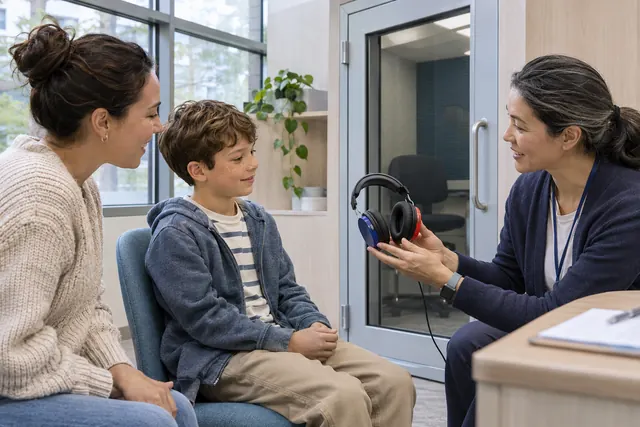

Auditory processing disorder, often called APD or CAPD, is a clinical term used for difficulty processing auditory information in the brain. A child who struggles to follow spoken information may need help, but those difficulties do not establish an APD diagnosis. Assessment must consider hearing and other possible contributors, including language, attention, and learning.1
For families, the most useful starting point is usually concrete: What is your child finding difficult, where does it happen, and what makes communication easier? You can begin addressing those needs while an assessment pathway is being worked out.
A listening difficulty is real even when its explanation is unclear
A child may follow a conversation at home but miss instructions in a busy classroom. They may understand a short request and become lost when several steps arrive together. They may ask for repetition, answer a different question, or need longer to respond.
These observations are worth sharing with professionals. They are not specific to APD. A checklist found online cannot distinguish among the many reasons a child might have trouble listening.
Try describing the situation without a conclusion about motivation. “They followed the instruction after it was written down” gives more information than “They never listen.” Ask the child what they noticed, too. A younger child might describe a room as “too many voices”; an older child might say that copying from the board makes it hard to hear the next instruction.
Why the diagnosis can be complicated
Professionals do not all define or assess APD in the same way, and there is no single accepted reference test that settles every case.1 This can be frustrating when you want a clear answer, but it is a reason to ask careful questions rather than accept a quick label.
Begin with a hearing assessment. A specialist option is an audiologist with experience in pediatric auditory processing assessment, working with speech-language, educational, developmental, or psychological professionals as needed. Ask how the team will connect its findings to support.1,2
Using more than one language does not itself mean that a child has a processing disorder. Assessment should account for the languages they use and the context in which they learned them.1 Ask whether the test materials and interpretation are appropriate for your child.
What to bring to an appointment
Collect a small number of specific examples from different settings. You do not need a lengthy diary. For each example, note what was being said, the surroundings, and what helped.
An illustrative school example is: “During a practical science task, the teacher gave the next three steps while classmates were moving equipment. My child completed the first step. They finished the task after seeing the remaining steps written down.” That describes a functional need without claiming a diagnosis.
Bring relevant hearing results, school reports, language or learning assessments, and a brief history of concerns. Tell the clinician about changes in hearing, ear problems, developmental history, and any relevant medical events. Ask the school to include strengths and successful strategies, not only difficulties.
If possible, involve the child in choosing one question for the visit. “Why can I hear you but miss the words at school?” is a useful question even if they cannot explain the difficulty in clinical terms.
What an assessment can and cannot tell you
Ask the clinician to explain what each assessment measures and how the results fit together. A test of hearing sounds, a test involving speech in competing sound, and a language assessment answer different questions. No single score should be treated as a complete description of your child.
The suitability of individual tests depends on factors such as development, language, attention, and available age-appropriate norms. Ask whether a proposed test can be interpreted reliably for your child now, and what can be done if it cannot.
At the end, request a plain-language explanation of the findings. You should understand which difficulties were demonstrated, what remains uncertain, and why each recommendation is being made. If the assessment does not result in an APD diagnosis, ask how the documented listening concerns will still be addressed.
Make information easier to access at home
Start with one routine that often becomes difficult. For an illustrative morning routine, replace a shouted list from another room with a brief face-to-face request and a visible sequence of steps. Give the child a way to check what comes next without repeatedly asking an adult.
When an instruction is misunderstood, try different wording or a visual cue. Ask the child to show the next step rather than relying on “Did you hear me?” This can reveal a misunderstanding without making them feel tested.
Keep expectations proportionate to the task. Explaining a new board game while a television is playing creates several demands at once. Turning the television down and demonstrating one turn is a practical change regardless of the eventual diagnosis.
Agree on a phrase the child can use, such as “One part at a time, please.” Adults should respond helpfully when the child uses it, so requesting access becomes worthwhile.
Work with school on specific listening situations
A support conversation is easier when it starts with the task rather than only a diagnostic label. Explain when your child misses information and ask the teacher what they observe. Include the child’s own preferences when possible.
Possible ideas to discuss include written key instructions, checking understanding privately, reducing avoidable competing sound, and arranging a seat that supports access to the teacher and classmates. The right location may change between whole-class teaching, group discussion, and practical work.
A remote microphone or another assistive listening option may be considered after appropriate professional assessment. These systems change how speech reaches the listener, and their suitability and benefit need to be checked individually.3 Purchasing equipment without a fitting and classroom plan may leave important problems unsolved.
Formal educational plans and available services vary by location and individual eligibility. Ask the school which process applies, who coordinates it, and when support will be reviewed. An article cannot determine a child’s legal entitlement.
Be careful with treatment promises
Before buying a training program, ask what problem it is intended to address, which children were studied, and what outcome improved. A program that raises a score on its own exercise has not necessarily shown that it improves classroom participation, reading, or language.
Ask who will select activities and monitor progress. A recommendation should explain how the program fits other support rather than replacing necessary hearing, language, or educational care. No brand name or claim about “rewiring the brain” removes the need for that explanation.
Choose a real-world goal and a review date. For example, a team might monitor whether the child can begin a classroom task after receiving its instructions in an accessible format. If the plan is not helping, revisit the explanation and the support instead of increasing demands automatically.
Your child should not have to earn accessible communication
Support can begin before every diagnostic question is resolved. The aim is to help your child understand information, participate, and ask for what they need. Preserve their interests, relationships, and time away from therapy-style activities.
If hearing suddenly changes, seek medical care immediately.4 For ongoing concerns, arrange an appropriate hearing evaluation and ask how school and clinical professionals can share useful information with your consent. Your next step is a clearer picture of your child’s needs and a practical plan to meet them.