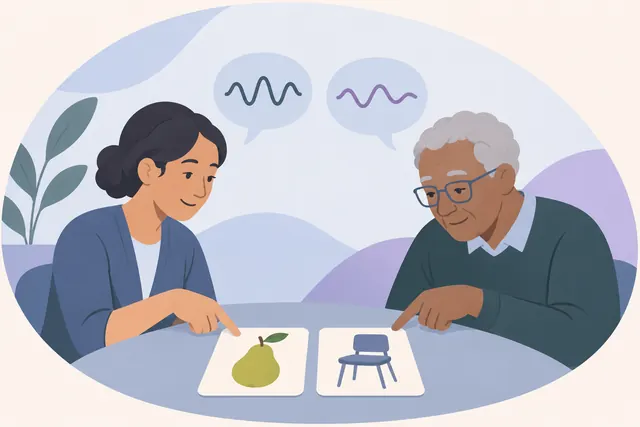

A speech-in-noise activity lets you practice following a short spoken message while a low level of background sound is present. Begin with speech you can follow comfortably in quiet. If your clinician agrees that added sound is suitable, introduce it gently and keep a clear way to reduce or stop it.
This is an illustrative home activity, not a hearing test or an exposure treatment for sound sensitivity. If ordinary sounds are painful or lead to a marked symptom increase, seek individual advice before adding noise.
Choose a practical listening task
Use a short passage with a transcript, or ask a partner to read a few sentences that you can check afterward. Choose familiar language and a topic you understand. The aim is to follow the message, not to test knowledge of unfamiliar words.
For example, a partner could say: “The appointment is on Thursday. Please arrive a little early and bring the form.” You might identify the day and the thing to bring. This example is a practice message; use written confirmation for real medical instructions.
Alternatively, choose a short story and explain its main point in your own words. If recalling details is difficult for reasons beyond hearing, use fewer details, pictures, or written choices. Agree what you are practicing before judging the answer.
Set up comfortable listening in quiet
Use the hearing devices and audio connection your care team recommends. Check that speech is comfortably audible without turning it up to a harsh level. A streamed recording, headphones, and room speakers can create different listening conditions, so note which you use.
Try the passage in quiet first. If it is already difficult, keep the background quiet and make the speech task easier. A shorter passage, a familiar voice, or visual support may be more useful than introducing another competing sound.
There is no need to simulate a busy restaurant at home. The value of practice depends on the listening goal and your response, not on how much noise you can tolerate.
Add only a manageable background
If suitable, use a steady, gentle background that you can control independently from the speech. Keep it low enough that the message remains manageable. You do not need a particular decibel level or a fixed signal-to-noise ratio for this home example; those settings require appropriate equipment and clinical interpretation.
Avoid sudden, startling sounds. Do not use hazardous noise, and do not increase the speech and background together in an effort to make the exercise harder. A comfortable task can still demand attention.
Sonara publicly describes speech-in-noise activities and adjustable practice conditions. Follow the instructions available in your version and any guidance from your clinician, rather than assuming that the setup described here matches an app control.1
Listen, check, and try a repair strategy
Listen once, then state the main point or choose the agreed detail. Check the answer using the transcript or your partner's explanation. If you missed something, identify what would help: a repeated phrase, slower delivery, the topic in advance, or a written keyword.
For a second attempt, change just one factor. You might reduce the background, use a shorter passage, or add the speaker's face. This helps you notice which support is useful. Repeating the same sentence can make it familiar, so use a new example if you want to explore whether the strategy helps with unfamiliar material.
Practice a specific request such as, “I heard Thursday; what should I bring?” That is a useful communication action even when you do not catch every word on the first attempt.
Keep the result in perspective
Speech-in-noise research has found different results across participants and programs. In one small study, experienced adult cochlear implant users improved in moderate noise after phoneme training, while the difficult-noise condition did not show a significant improvement.2 That finding does not establish that this home exercise or any particular app will produce the same result.
The home activity also cannot measure your clinical speech-in-noise ability. Record the passage type, listening setup, support used, and comfort if that will help a discussion with your clinician. Avoid comparing a score from a quiet, familiar passage with one from unfamiliar speech in more noise as if they were equivalent.
Apply what you notice to an ordinary conversation
Choose one practical change for the next real conversation. It might be moving away from a loudspeaker, asking one person to speak at a time, or requesting a written detail. Assistive listening technology can also help in some settings; an audiologist can explain suitable options.3
Pause practice when you become uncomfortable or excessively tired. Stop and seek advice for pain, worsening sound intolerance, or new hearing symptoms. You do not need to complete a target number of items through discomfort.
Finish by asking a useful question: “What helped me follow the message?” The answer can guide the next activity and the next conversation.