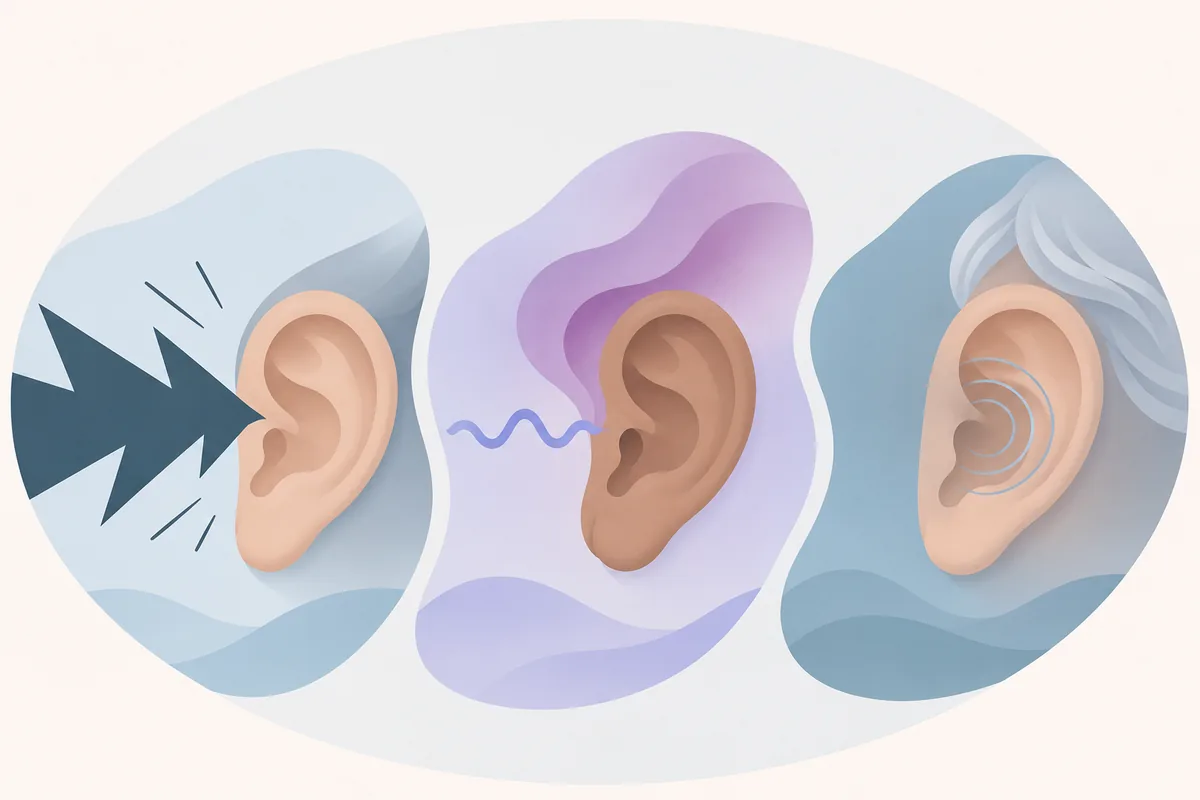
Tinnitus is hearing a sound that has no external source. Hyperacusis involves difficulty tolerating external sounds, often because they seem too loud, uncomfortable or painful. Misophonia involves a strong reaction to particular sound patterns or sources, which may be relatively quiet. These descriptions help organize a conversation; they do not replace a clinical assessment.1,2
A person can have more than one concern. The right next step depends on what happens, which activities are affected and whether hearing or other health symptoms need attention.
A side-by-side comparison
| Feature | Tinnitus | Hyperacusis | Misophonia |
|---|---|---|---|
| Where does the sound come from? | There may be no matching sound in the environment | An external sound is present | A particular external sound or associated cue is present |
| What might someone report? | “I hear a tone when the room is quiet.” | “Ordinary sounds feel painfully loud.” | “That repeated sound brings an immediate strong reaction.” |
| What detail helps assessment? | Timing, side, hearing changes and effect on life | Loudness, discomfort or pain, context and duration | Trigger pattern, context, reaction and effect on activities |
| What can overlap? | Hearing difficulties, sleep disruption or sound intolerance | Tinnitus, hearing concerns or other sound reactions | Other sound-tolerance concerns or distress |
The table summarizes broad distinctions using the NIDCD tinnitus overview and the VA's sound-tolerance assessment framework.1,2 Individual experiences can be more complicated than one column.
The same setting can raise different problems
Imagine three people in a café. One hears ringing during a pause in conversation. Another finds the espresso machine physically uncomfortable. A third reacts strongly to a nearby repetitive eating sound even though the machine is not a problem.
Those experiences point to different questions. Turning on louder background sound may not help all three people. Neither would telling everyone to ignore the sound. A useful plan begins by understanding the particular difficulty, rather than assigning a sound-based intervention because all the problems involve listening.
Now imagine one person experiences all three. They do not have to decide which label is “the real one” before asking for help. Describing each concern separately can make assessment more useful.
Loudness is only part of the story
For some sound-tolerance problems, the level and physical discomfort are central. For others, the source, repetition or meaning of a sound matters more. A response may also vary by setting. These patterns are among the issues addressed in the VA Sound Tolerance Interview.2
Try noting what you actually experienced rather than judging whether a sound was objectively annoying. Useful observations include “sharp sounds hurt,” “I react especially when I cannot leave the room,” or “the problem occurs only when my hearing aids are on.” The last example is a reason to discuss device settings and fit with your audiologist, not to assume a diagnosis from a website.
Pain deserves explicit mention. Avoid substituting the vague word “sensitivity” if it hides an important part of what is happening.
A hearing test can be part of the picture
Hearing and sound-tolerance questions are related, but they are not identical. A clinician may assess hearing alongside tinnitus and external-sound concerns. The VA Tinnitus and Hearing Survey separates these areas so that one does not automatically stand in for the others.3
You might find conversation difficult in background noise while also being uncomfortable around some louder sounds. Explain both. A plan focused only on making speech louder may need adjustment if comfort is also a concern. Conversely, a sound-sensitivity label should not prevent assessment of a hearing change.
Ask what each test is intended to answer and tell the clinician before testing if sound has caused pain or prolonged symptoms. You can discuss how the assessment will be adapted and how to signal that you need a pause.
Why the distinction changes care
For bothersome tinnitus, care may include hearing support, education, tinnitus-focused CBT and individualized sound options. Their aim is often to reduce the burden of tinnitus rather than remove the sound.4
For sound intolerance, assessment needs to establish the particular pattern and practical impact before choosing a plan. A recording that makes tinnitus less noticeable is not automatically suitable for someone with sound-induced pain. A strategy developed for one person's specific triggers is not a general exposure prescription for everyone.2
Care can involve more than one professional. Depending on your concerns, that may include an audiologist, an ENT clinician and a behavioral health professional. Ask who is addressing which problem so that advice does not conflict or leave an important need unaddressed.
What to bring to an appointment
Choose two or three examples rather than an exhaustive sound inventory. For each, describe the setting, what you heard, the reaction, how long it lasted and what you could not do as a result. Include any hearing device use, recent noise exposure, ear symptoms or relevant health changes.
A short statement such as “I need help attending meetings without pain” gives the clinician a practical goal. A family member can help record questions if you want, while leaving you in control of how your experience is described.
When to seek help promptly
A sudden reduction in hearing needs urgent medical assessment, even if ringing or sensitivity seems to be the main issue.5 Call emergency services for new symptoms that could indicate a stroke, such as facial drooping, arm weakness or difficulty speaking. Other acute severe symptoms need urgent medical advice. Tinnitus that pulses with the heartbeat or persistent one-sided symptoms also merit medical assessment rather than self-diagnosis.4
You do not need a perfect label to seek support. Start with a clear description of the experience and its effect on your life; let the assessment guide the terminology and next steps.