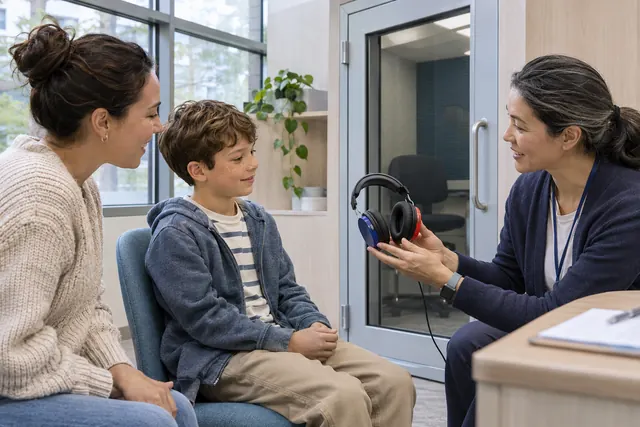
Sound sensitivity in a child can mean several different things: sounds may feel too loud, cause discomfort or pain, or trigger a strong reaction in a particular situation. Start by listening to the child's description and noting what the difficulty prevents them from doing. If it is persistent, painful or interfering with daily life, discuss it with a pediatric healthcare professional or audiologist.
Research on childhood hyperacusis describes varied presentations and limited evidence for a standard assessment or treatment approach.1 A child's needs therefore deserve an individual plan, rather than an adult sound routine or a promise that the problem will disappear with age.
Ask what the child experiences
“Does the sound bother you?” may be a starting point, but it does not reveal much about the experience. A child may mean that it hurts, startles them, makes talking difficult or feels upsetting for another reason.
Try an open invitation: “Tell me what happens when you hear that.” Give time for an answer. A younger child might point, draw or demonstrate where they feel discomfort. A teen may prefer to write a note or discuss it privately with a clinician. Avoid repeatedly offering alarming explanations or asking the child to reproduce the reaction.
Record the child's words separately from your interpretation. “My ears hurt when the plates bang” is useful information. So is “I cannot hear the teacher when everyone talks.” Those examples may call for different assessment questions.
Notice the effect on ordinary activities
Choose a few situations that show what needs support. Consider meals, dressing, travel, play, school, bedtime and family outings. Does the child leave an activity? Need a long time to settle afterward? Have trouble hearing instructions? Refuse a setting they previously enjoyed?
Write down what happened before and after the difficult moment, including any hearing-device use or recent ear symptoms. You do not need a detailed sound log for every day. A short record can help an appointment stay focused without making the household revolve around symptom monitoring.
The child may experience difficulty in one setting and not another. Treat that as information to explore, rather than proof that they are choosing when to react. At the same time, avoid deciding on a diagnosis from the pattern alone.
Arrange an assessment that fits the child's age
A pediatrician, primary care clinician or pediatric audiologist can help determine the next step. Ear symptoms, hearing changes, pain and broader developmental or health concerns may affect which professionals should be involved. Sound sensitivity alone should not be used to assign another diagnosis.
Before the visit, tell the clinic if sound has caused pain or symptoms that last afterward. Ask how testing will be explained, how the child can request a pause and whether the environment can be adjusted. Bring previous hearing results, a medication list and the brief examples you collected.
At the appointment, give the child an opportunity to answer before adding your observations. If you need to discuss something sensitive without the child listening, ask the clinician how to do that appropriately. A useful assessment includes both the family's concerns and the child's own experience.
Distinguish hearing protection from a universal treatment plan
Children still need protection from hazardous noise. Lowering unnecessary volume, increasing distance from loud sound and using appropriate protection where needed are ways to reduce the risk of noise-induced hearing loss.2
Ordinary sound-tolerance decisions are more individual. Ask the clinician when protection is appropriate for your child and how it affects communication, comfort and daily activities. Do not assume that continuous protection is the answer to every setting or that it should be removed according to a timetable found online.
If a device or activity is suggested, ask what it is meant to do and how you will tell whether it helps. A plan should say what to do if the child reports pain, becomes markedly distressed or has lasting symptoms. Forcing a child to remain in a painful setting is not a substitute for assessment.
Make home routines more predictable
Practical changes can reduce avoidable surprises while you arrange care. You might tell the child before starting a noisy household task, allow them to choose a different room when appropriate or agree on a signal to ask for help. These are examples to adapt, not a treatment protocol.
For an original example, a family preparing dinner might let a child know before using a noisy appliance and arrange another activity nearby with an adult. Later, they discuss whether that change made the routine easier. The goal is to help the child participate in family life in a workable way.
Avoid repeatedly testing whether the child still reacts. Ask relatives and siblings not to imitate difficult sounds as a joke. It is also reasonable to protect siblings' needs; one child's support plan should not require another child to become a full-time monitor of the environment.
Coordinate school support around specific situations
A teacher needs more than the instruction “avoid noise.” Share the settings that are difficult, any clinician guidance and what the child can do to ask for help. Discuss how the plan will preserve learning, friendships and participation.
Possible questions include whether written instructions would help, how a supervised break would work, who supports the child during a difficult transition and how the child returns to an activity. Safety procedures and emergency alerts must remain accessible; any drill arrangements should be coordinated with the school.
Agree on a contact person and review date. Ask the child what they want classmates to know. A concise explanation may be enough, and some children will prefer to keep health details private.
Be cautious with adult treatment claims
A method studied in adults is not automatically established for children. The pediatric hyperacusis literature remains limited, so claims about guaranteed improvement, required exposure or a single best sound dose need scrutiny.1
Ask a professional to explain how a proposed approach fits the child's age, communication abilities, symptoms and goals. Find out what family involvement is expected, how outcomes will be reviewed and what happens if the approach is uncomfortable or impractical.
An app marketed for relaxation, hearing exercises or tinnitus does not establish suitability for a child with sound sensitivity. Check intended users and discuss the particular activity with the child's care team before treating it as part of clinical care.
Know when to seek help promptly
A sudden reduction in hearing requires urgent medical assessment.3 New severe ear symptoms, symptoms following an injury or a child who appears acutely unwell also warrant medical advice. Do not wait for a school meeting or a planned sound-tolerance follow-up to address an acute change.
For ongoing symptoms, review whether the child is able to do more of what matters: attend a lesson, enjoy play, eat with family or sleep comfortably. Ask about the child's feelings as well as visible behavior. A quieter reaction is not the only measure of a useful plan; participation, comfort and the child's own view matter too.