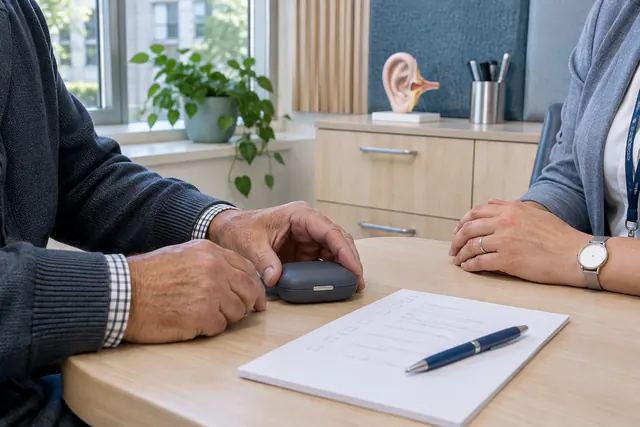

If you can hear voices through your hearing aids but cannot make out the words, the problem deserves a specific review. It may relate to the devices, their fitting, the listening environment, your hearing needs or more than one of these. More volume or more practice will not necessarily resolve it.1
Begin by describing when the difficulty happens and whether anything changed. That information helps your audiologist decide what to check and gives you something practical to work with in the meantime.
First, notice whether the change is sudden
If your hearing has suddenly dropped, especially in one ear, seek medical care immediately. Do not assume the hearing aid is the only problem or wait for a routine adjustment. Sudden hearing loss can develop all at once or over a few days and is a medical emergency.2
An abrupt device problem also deserves attention, but finding a low battery does not rule out a hearing change. Tell the clinician about the change in your hearing as well as what the equipment is doing.
For a longstanding difficulty with understanding, use the steps below to prepare a focused follow-up.
Step 1: turn a general complaint into a clear example
Choose a recent conversation and describe the setting. Were you in a quiet room or a busy restaurant? Was the speaker beside you or across the table? Could you see their face? Did one voice cause more difficulty than another?
Then describe the experience without trying to diagnose it. Useful examples include:
- “The voice is loud enough, but some endings disappear.”
- “I understand one person until someone else starts talking.”
- “Phone calls are much harder than face-to-face conversations.”
- “My own voice is uncomfortable, so I keep turning the aids down.”
These examples are illustrative. Your own words are more useful than choosing a technical term you are not sure about. Include a situation that works well, because the contrast may help clarify the problem.
Step 2: check the equipment using your usual instructions
Follow the basic checks you were taught: power or charge, correct placement and any cleaning or replacement of user-serviceable components specified for your model. Do not insert unfamiliar tools into the aid or ear, and do not change parts you have not been shown how to maintain.
If you use an app or remote control, note which program and volume were selected. A screenshot of settings can be useful if it contains no information you do not want to share. Avoid making multiple changes at once, because that makes it harder to know what helped.
Contact the hearing service if a device seems distorted, intermittent or consistently different from usual. A fitting and maintenance review is part of hearing aid care, not evidence that you have failed to adjust.1
Step 3: try one change to the conversation
Choose a change you can make immediately and observe whether it helps. Move closer to the speaker, turn off a nearby television or ask to speak in a less echoing space. If you are in a group, ask one person to speak at a time.
Use a targeted request when you miss information. Instead of “What?” after every sentence, try “I caught the topic, but not the person's name” or “Please say the last two numbers again.” The other person then knows what to clarify.
For essential information, use another format. Ask for the appointment time in writing, turn on captions for a call or confirm a work instruction by message. Accurate communication matters more than demonstrating that you can hear everything unaided by text.
Step 4: arrange a follow-up with the right questions
Ask the audiologist to review both device performance and your communication goals. Depending on your situation, they may consider whether the fitting is appropriate, whether additional hearing assessment is needed and whether an accessory or another approach would be useful.1
Bring your hearing aids, any accessories involved and a short note of the situations you want to discuss. If calls are the main issue, identify the phone and connection you use so the team can reproduce the setup when feasible.
Ask: “What can we verify today?” and “What should I try before the next visit?” You can also ask what benefit is realistic for your hearing profile and whether a different technology or referral should be considered. The answers should be individualized rather than promises that a premium device or a particular exercise will solve every difficulty.
Step 5: test additional listening support when appropriate
A remote microphone can help bring a particular speaker's voice closer to your listening system. Hearing loops and other assistive systems may help in equipped venues, while captions provide visual access to spoken information.3 These options require appropriate setup and, where relevant, compatibility checks.
Define the situation before choosing the tool. A one-to-one conversation across a room is different from a rapidly changing group discussion. Ask how the proposed support would work in your actual setting and whether you can try it before committing to it.
A device that adds inconvenience without improving access may not be the right choice. Discuss ease of handling, charging, connection, cost and the cooperation needed from other people.
When to consider structured listening practice
Practice is most useful to discuss after the device and access questions have been addressed. Ask what task it would target and how progress would be assessed outside the activity. A manageable exercise might focus on following a short message or asking for the specific detail that was missed.
Training should not become an open-ended instruction to “try harder.” Agree on a review point and what would lead you to change or stop the activity. If conversation becomes easier because of better seating, captions or an accessory, that is valuable progress too.
Leave the appointment with a next step you can describe
A useful plan might be: “Use the recommended meeting setup, record two examples and contact the clinic if the sound remains distorted.” It should name the change, how you will evaluate it and when to follow up.
Hearing aids can help substantially while leaving some challenges unresolved. The aim of follow-up is to understand those remaining challenges and build a communication plan that works in your life.